
॥ Achyutam Keshavam ॥
A beautiful Sanskrit bhajan to Lord Krishna — perfect for morning devotion
Full Text
Acyutam keśavaṃ kṛṣṇa dāmodaraṃ
Rāma nārāyaṇaṃ jānakī vallabham
Meaning: The infallible one, Keshava (Vishnu), Krishna the Damodara (bound by rope of love), Rama the husband of Janaki (Sita) — Narayana!
Verse 1
Kausalyā-sutaṃ Rāmaṃ bhaje saumitrī-saṃyutaṃ
Śrī Rāmacandraṃ bhajāmi
Meaning: I worship Rama, son of Kaushalya, together with Lakshmana (son of Sumitra). I worship the moon-faced Lord Ramachandra!
Verse 2
Govardhana giridhar, he giridhar nāgara
Muralī manohara, he rādhā ke sāgara
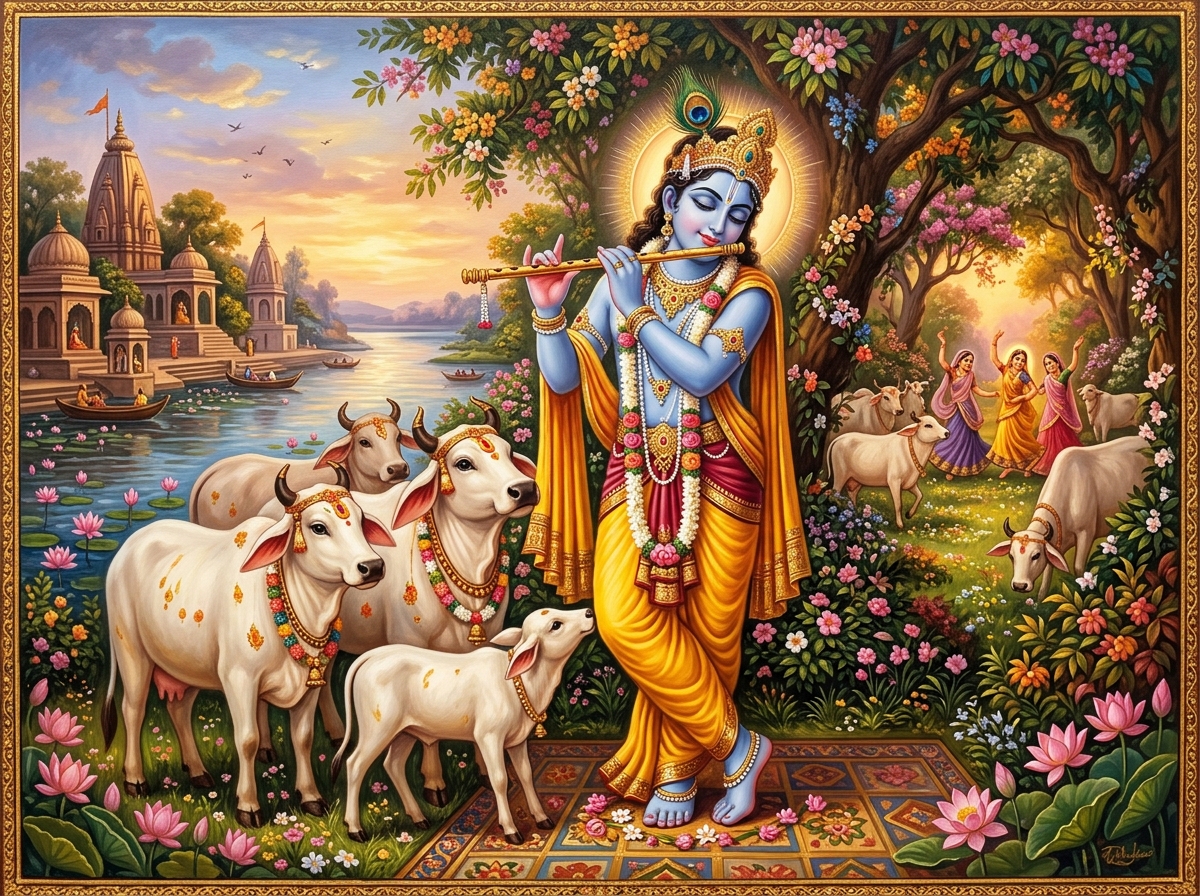
Gopī jana vallabha, gokula ke prāṇa
Kṛṣṇa murārī jaya, jaya jagata kalyāṇa
Meaning: O Giridhar (one who lifted Mount Govardhan), clever Giridhar Nagar! O enchanter with the flute, O ocean of Radha’s love! Beloved of the gopis (devotee-maidens), the very life of Gokul! Victory to Krishna Murari — victory to the welfare of the entire world!
Verse 3
Rādhe Kṛṣṇā Rādhe Kṛṣṇā
Rādhe Rādhe jaya Śyāma
Jaya Govinda jaya Gopāla
Jaya Śrī Kṛṣṇa hare Rāma
Meaning: Radhe Krishna, Radhe Krishna! Radhe Radhe, victory to Shyama (the dark-complexioned one)! Victory to Govinda, victory to Gopala! Victory to Shri Krishna — Hare Rama!
The Names of Krishna in This Bhajan
| Name | Meaning |
|---|---|
| Achyutam | The infallible, never-falling one |
| Keshavam | Long-haired; destroyer of the demon Keshi |
| Dāmodara | Bound by a rope (dāma) around the belly (udara) — by Yashoda’s love |
| Giridhar | Lifter of the mountain |
| Nāgar | The clever, sophisticated one |
| Murali Manohara | Enchanter with the flute |
| Gopi Jana Vallabha | Beloved of the gopis |
| Govinda | Protector of cows; known through the Vedas |
| Gopāla | Cowherd; protector of the earth |
| Murāri | Enemy of the demon Mura |
| Śyāma | The dark-complexioned one |
The Story of Damodara — Bound by Love
One of the most beloved stories of Krishna’s childhood is the Damodara Lila — when his foster mother Yashoda tried to tie him to a mortar to punish him for stealing butter.
Despite being the Supreme Lord who holds the entire cosmos in his being, Krishna — out of pure love for his devoted mother — allowed himself to be caught and tied. The rope was always too short. Yashoda kept adding rope, bewildered. Finally, when tears of love filled her eyes, Krishna allowed himself to be bound.
The great saint Surdas wrote: “Even the Vedas could not find Him; even Shiva and Brahma could not see Him — but the little butter-thief allows himself to be bound by the rope of his mother’s love.”
Damodara thus represents one of the most profound mysteries of divine love: the infinite becomes finite for the sake of love. The immeasurable makes itself measurable for the sake of relationship.
Radha and Krishna
The names “Radhe Krishna” in verse 3 point to the central relationship of the Vrindavan tradition: Radha and Krishna — the devotee and the Lord, the human soul and the divine, longing and fulfillment.
Radha is not merely Krishna’s consort — in the Bhakti tradition, she represents the ideal devotee: one whose entire being is dissolved in love for the Divine. Her love for Krishna is so complete that she has no separate existence — she exists only in relation to him.
The joint name “Radhe Krishna” expresses this: they are two but inseparable, as a single flame that appears as light and heat.
When to Sing
- Janmashtami — Krishna’s birthday
- Morning kirtan — this bhajan is especially beautiful at dawn
- Raas Leela celebrations — Vrindavan, Mathura, and throughout India in Kartik month
- Any time of day — the names of Krishna carry grace at any moment
Phala Shruti
Acyutaṃ keśavaṃ yo gāyet bhaktyā sarvadā
Tasya mokṣo na sandihya, kṛṣṇānugrahataḥ sadā
“Whoever sings the names Achyutam Keshavam always and with devotion — liberation is certain for that person, for they are always under the grace of Lord Krishna.”