॥ Holi — The Festival of Colors ॥
The Most Joyful Festival of the Hindu Calendar — Phalguna Purnima
What is Holi?
Holi is the great spring festival of colors, celebrated on the full moon night of the month of Phalguna (February-March). It is perhaps the most exuberant, most universally joyous festival in India — a day when the normal boundaries of social life are temporarily dissolved, when everyone plays equally, and when the world is transformed into a landscape of color, laughter, and love.
At its heart, Holi celebrates:
- The victory of devotion over evil — the story of Prahlad and Holika
- The arrival of spring — the renewal of life after winter
- The divine love of Radha and Krishna — the love that colors the whole world
The Stories of Holi
Story 1: Prahlad and Holika
The demon king Hiranyakashipu was so proud of his power that he declared: “I alone am God! No one may worship any other!”
His own son Prahlad refused. From childhood, Prahlad was an unshakeable devotee of Lord Vishnu. No amount of punishment could make him stop chanting “Om Namo Narayanaya.”
Hiranyakashipu tried everything — having Prahlad thrown off a cliff, trampled by elephants, bitten by serpents. Each time, Lord Vishnu protected his young devotee.
Finally, Hiranyakashipu’s sister Holika — who possessed a magical shawl that made her immune to fire — agreed to carry Prahlad into a bonfire. But when they entered the flames, the shawl flew from Holika and wrapped around Prahlad instead. Holika burned; Prahlad emerged unharmed, continuing to chant Vishnu’s name.
This event is commemorated with Holika Dahan — the bonfire lit on the evening before Holi, symbolizing the burning of evil and the protection of sincere devotion.
Story 2: Radha and Krishna’s Color Play
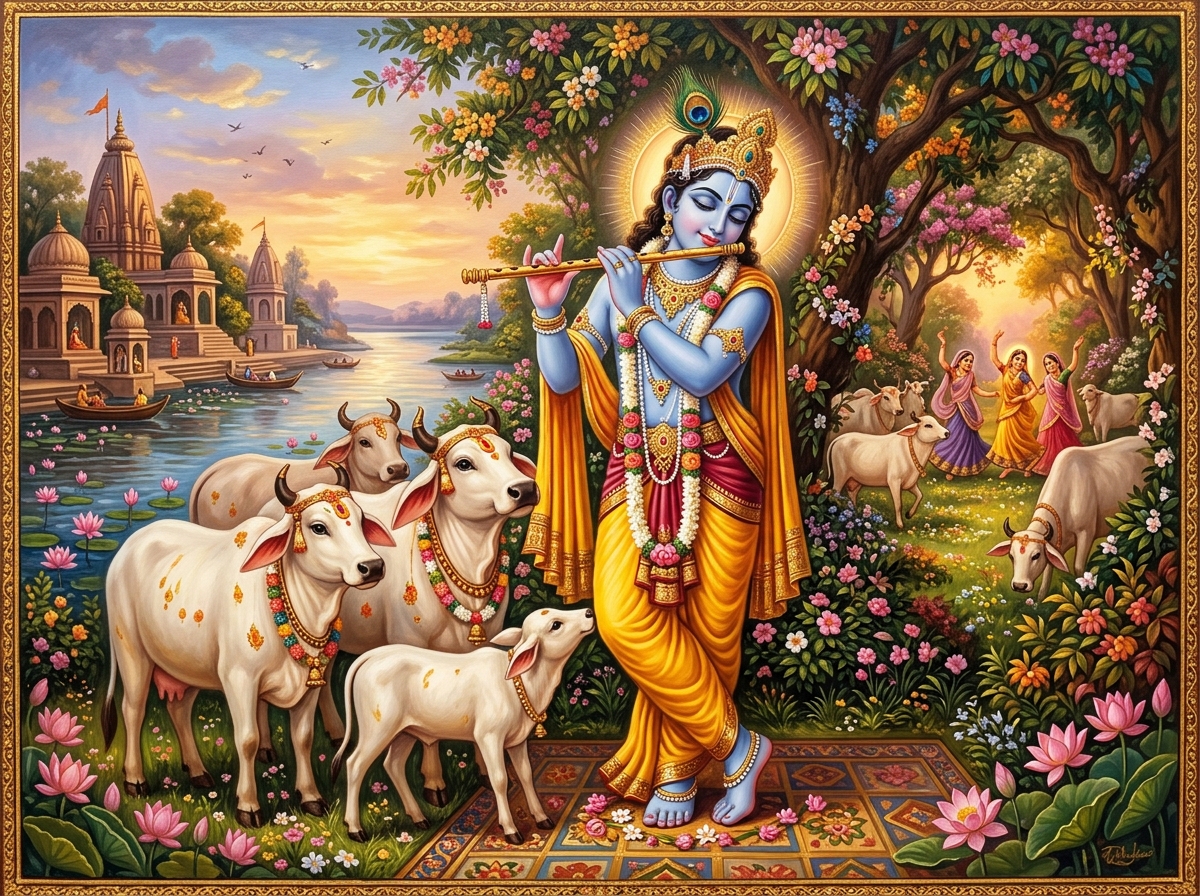
In Vrindavan, the young Krishna was once troubled by his dark blue complexion compared to Radha’s golden fairness. His mother Yashoda told him playfully: “Go and color Radha’s face however you like!”
Krishna and his friends went to the gopis and drenched them with colored water. This divine play (leela) of colors became the model for Holi in the Vaishnava tradition.
The Holi of Vrindavan and Barsana (Radha’s village) is world-famous:
- Lathmar Holi in Barsana — women playfully beat men with sticks (lathi)
- Phoolon wali Holi — Holi played with flowers instead of colors
The Spiritual Meaning of Colors
Each color in Holi carries a spiritual significance:
| Color | Significance |
|---|---|
| Red | Love, fertility, beauty — Eros and divine love |
| Yellow | Auspiciousness, purity, Vishnu’s color |
| Green | New life, nature, growth, renewal |
| Blue | Infinity, Krishna’s divine color, the cosmic sky |
| Orange/Saffron | Renunciation, fire, the spiritual quest |
| White | Purity, peace, Shiva’s color |
When we play Holi, we are literally coloring each other with divinity — splashing the cosmic colors of creation on the world and on each other.
The Deeper Symbolism: Dissolving Boundaries
The most radical spiritual dimension of Holi is its social dimension. On Holi:
- Caste boundaries dissolve — everyone plays together
- Age barriers dissolve — children and elders are equals
- Gender norms relax — women traditionally have more latitude
- Hierarchy dissolves — even masters and servants play equally
This one day of radical social equality is the Hindu tradition’s reminder: beneath all the roles and hierarchies of daily life, we are ultimately equal — children of the same divine playfulness.
The Sufi poet Rumi would have recognized Holi: it is the festival that celebrates the divine intoxication (wajd) that dissolves all separateness and returns everything to the original oneness.
Holika Dahan — The Night Before
On the evening before Holi (Phalguna Purnima):
- Gather wood, dry branches, and cow dung cakes into a large pile
- Place an image of Holika (the demoness) and Prahlad (as a child) in the center
- As the moon rises, light the fire
- Circumambulate the fire three times, praying for the burning away of all evil within
- Roast coconut, new grain, and corn in the fire’s edge as an offering of the first spring harvest
- Collect a small amount of the ash to apply on the forehead the next morning
Playing Holi — The Day of Colors
The morning after Holika Dahan is the main celebration:
Traditional Method:
- Use natural colors — made from flowers, turmeric, henna
- Pichkari (water gun) filled with colored water
- Wet gulal (colored powder)
The Order:
- Elders apply color to each other first — as a mark of respect
- Then the full free-for-all begins
- People sing Holi songs (Holi ke geet), dance, drum
- The celebration continues until noon
- Everyone bathes, changes clothes, and visits friends and family
Prasad and Food: Traditional Holi foods include:
- Thandai — a spiced milk drink
- Gujiya — sweet dumplings filled with khoya and nuts
- Bhang — an edible preparation of cannabis (used traditionally in some traditions)
- Puran Poli — sweet flatbread
- Dahi Bhalle — lentil dumplings in yogurt
Holi in Vrindavan: The Most Sacred Celebration
Holi lasts for seven days in Vrindavan and Mathura — the land of Lord Krishna’s childhood. Each day has a different character:
| Day | Location | Name | Character |
|---|---|---|---|
| 1 | Barsana | Lathmar Holi | Women beat men playfully |
| 2 | Nandgaon | Lathmar Holi | Men’s turn to “defend” |
| 3 | Mathura | Holi Mela | Grand celebration |
| 4 | Vrindavan | Phoolon ki Holi | Flowers (at Banke Bihari temple) |
| 5 | Vrindavan | Rangbhari Ekadashi | Colors with bhajans |
| 6 | Braj region | Holika Dahan | Bonfires everywhere |
| 7 | All of Braj | Rang Panchami | Final day of colors |
Phala Shruti
Holikā dahane mukto, raṃga krīḍāṃ kṛtvā naraḥ
Sa sarva pāpa nirmukto, bhavati sukha saṃyutaḥ
“One who witnesses Holika Dahan and plays with colors on Holi — that person is freed from all sins and becomes filled with happiness.”
The Bhavishya Purana declares: “Holi is the festival of Brahma, Vishnu, and Shiva together — the celebration when the entire cosmos dances with the joy of divine love. Whoever participates with a sincere heart receives the blessings of all three great Lords.”
Jai Holi! Holi Hai! 🎨