
॥ Janmashtami — The Birth of Lord Krishna ॥
The Birthday of the World’s Greatest Teacher — Bhadrapada Krishna Ashtami
What is Janmashtami?
Janmashtami (Janma = birth; Ashtami = eighth day) is the birthday celebration of Lord Krishna — the eighth avatar of Lord Vishnu, one of the most beloved and complex divine figures in world religious history. It falls on the 8th day of the dark fortnight (Krishna Paksha) of the month of Bhadrapada (August-September).
When midnight strikes on Janmashtami, the exact moment of Krishna’s birth is celebrated with great joy — bells ring, conches sound, lamps are waved, and the image of baby Krishna is bathed and placed in a cradle while the entire congregation sings and dances.
The Story of Krishna’s Birth
The Prophecy
Long ago, the evil king Kamsa of Mathura was warned by a divine voice at his sister Devaki’s wedding: “O Kamsa, the eighth child of this woman will be the cause of your death!”
In a rage, Kamsa imprisoned Devaki and her husband Vasudeva. He killed each of their children one by one as they were born. By the time Devaki was pregnant with her eighth child, everyone knew this was the child of prophecy.
The Miraculous Birth
On a stormy midnight — the darkest night of the month, in the deepest darkness of the fortnight — Lord Krishna was born in the prison of Kamsa. The storms raged, lightning flashed, and yet in the prison, everything was calm.
At the moment of his birth, all the prison guards fell into a deep sleep. The prison chains fell from Vasudeva’s hands. The prison doors opened by themselves.
Lord Vishnu appeared before Vasudeva and said: “Take this child across the Yamuna to the home of my dear devotee Nanda in Gokul. Leave him there and bring back Nanda’s newborn daughter in his place.”
The Journey Across the Yamuna
Despite the midnight storm and the raging Yamuna river, Vasudeva placed the infant Krishna in a basket and balanced it on his head, crossing the flooded river. The river was in flood — but when Krishna’s feet touched the water, the river bowed in reverence and lowered itself to allow Vasudeva to cross.
As Vasudeva crossed, the great serpent Shesha (the eternal support of Vishnu) came behind and spread his hood over the infant like an umbrella against the rain.
The Exchange
Vasudeva arrived at Gokul, found Nanda’s wife Yashoda asleep with her newborn daughter, exchanged the babies, and returned to the prison with Yashoda’s daughter. When Kamsa came to kill the eighth child — it was a girl! He grabbed her and was about to dash her against a stone when she flew from his hands, transformed into the Goddess Yogamaya, and laughed: “Your destroyer has already been born elsewhere, foolish Kamsa!”
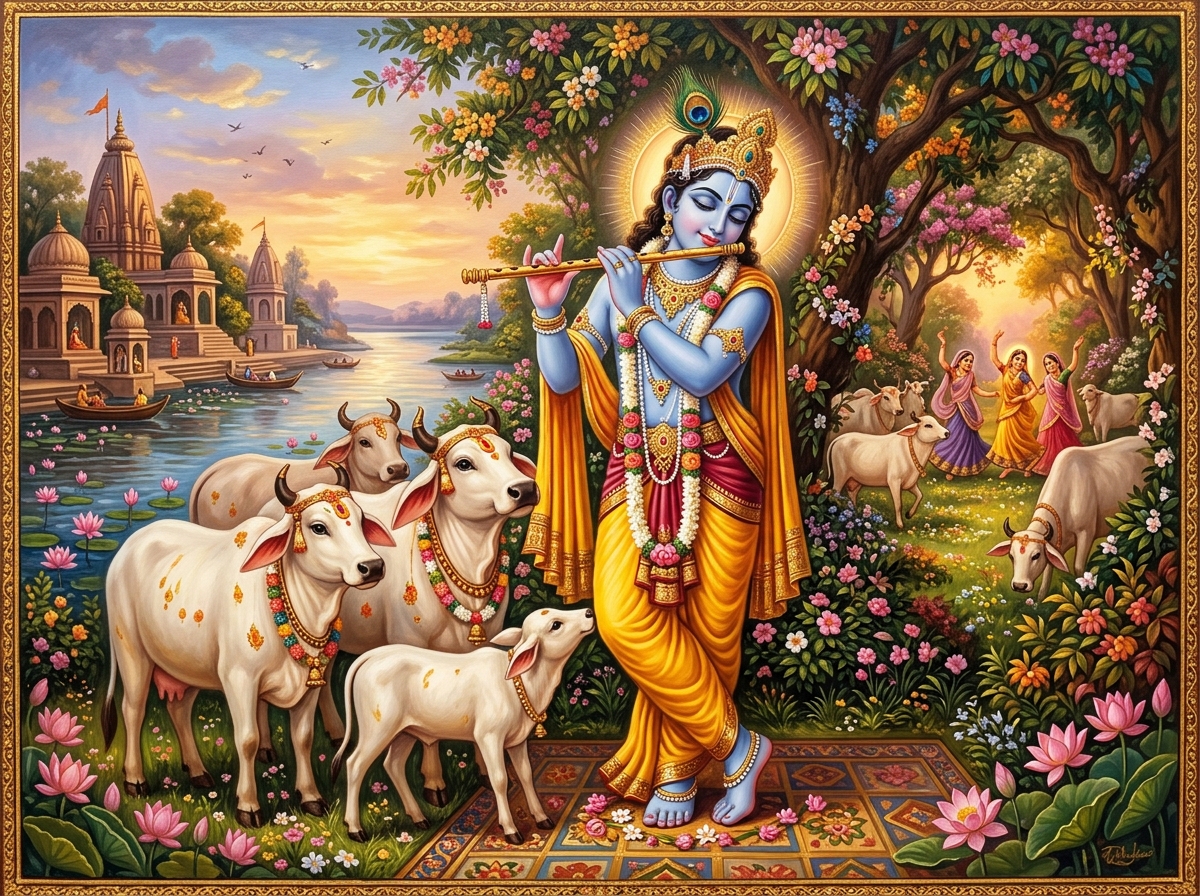
And so Krishna grew up in Gokul and Vrindavan — raised by the simple, loving cowherd family of Nanda and Yashoda, far from the schemes of kings and demons.
The Spiritual Significance
Why Was Krishna Born at Midnight?
Midnight on the darkest night represents the moment of maximum darkness — when there seems to be no hope, no light. This is precisely when the Divine manifests.
The message: the Lord is born in our darkest hour. When all outer support has failed, when we are imprisoned by our own fears, when the storms of life rage — in that precise moment, if we are open, the divine is born within.
Why Was He Born in a Prison?
The prison represents the ego — the sense of separate self that imprisons the divine consciousness within each of us. The birth of Krishna in prison says: divine consciousness is always present within the prison of the ego, waiting to be recognized.
The Name “Krishna”
Krishna means the dark one, the one who attracts, the one who ploughs:
- Dark — like the night sky, like the deep ocean, infinite and unfathomable
- Attracts — from the root karṣ — the gravitational force that draws all beings toward the Divine
- Ploughs — consciousness that turns over the field of the mind, making it ready for wisdom
How to Celebrate Janmashtami
Fasting (Upavasa)
Most devotees observe a complete fast until midnight — when Krishna was born. Some maintain a waterless fast (Nirjala); others take fruits and dairy.
Midnight Puja
The central celebration happens at midnight. Set up a cradle (jhula) near the puja area. At midnight:
- Bathe a baby Krishna image in Panchamrit
- Dress it in new clothes (traditionally yellow)
- Place it in the cradle
- Sing the lullaby “Nand ke anand bhayo, Jai Kanhaiya Lal Ki!”
- Ring bells, blow conches, offer flowers
- Distribute prasad — special sweets like panjiri, kheer, makhan-mishri
Dahi Handi
In Maharashtra, a beloved community celebration: dahi handi (curd pot). A clay pot filled with curd, butter, and milk is hung high, and groups of young men (Govindas) form human pyramids to reach and break it — recreating Krishna’s childhood exploits of stealing butter from high pots.
Reading Krishna’s Story
On Janmashtami day, families gather to read or hear the Bhagavata Purana, Skandha 10 — the full story of Krishna’s life from his birth to his great deeds. The recitation itself is considered a complete spiritual practice.
The 24 Hours of Janmashtami
| Time | Activity |
|---|---|
| Dawn (before Janmashtami) | Begin fast |
| Morning | Decorate the prayer area |
| Afternoon | Read Bhagavata, listen to katha |
| Evening | Aarti, bhajan, kirtan |
| Midnight | Main puja — Krishna’s birth |
| Post-midnight | Break fast with prasad |
| Next morning | Final aarti, charity |
Special Foods for Janmashtami Prasad
- Makhan (white butter) — Krishna’s beloved childhood food
- Mishri (rock sugar) — sweet offering
- Panchamrit — milk, curd, honey, ghee, sugar
- Panjiri — wheat flour roasted in ghee with sugar and nuts
- Kheer — rice pudding
- 56 dishes (Chappan Bhog) — in temples, 56 different food items are offered
Phala Shruti
Janmashtamyāṃ yo bhaktyā kṛṣṇaṃ pūjayet nityam
Sa sarva pāpa nirmukto yāti vaikuṇṭhamuttamam
“Whoever worships Lord Krishna on Janmashtami with sincere devotion is freed from all sins and attains the highest realm of Vaikuntha (Lord Vishnu’s abode).”
The Bhagavata Purana promises: “Whoever hears the story of Krishna’s birth with faith and love — even once — is freed from the karma of all their past lives. This is the power of Lord Krishna’s appearance in this world.”
The Deeper Teaching: The Krishna Within
The great Vaishnava philosopher Surdas wrote: “Krishna has not merely come once and gone. He is born fresh every moment in the heart of every devotee who sincerely calls him.”
Janmashtami is not merely a historical anniversary. It is an invitation for the devotee to ask: Where is Krishna being born in me this year? What new understanding is arising? What darkness is being illuminated in my own life?
The Lord is always being born — in every moment of genuine love, genuine creativity, and genuine devotion.