॥ Navratri — The Nine Sacred Nights ॥
Nine nights of worship of the nine manifestations of Goddess Durga
What is Navratri?
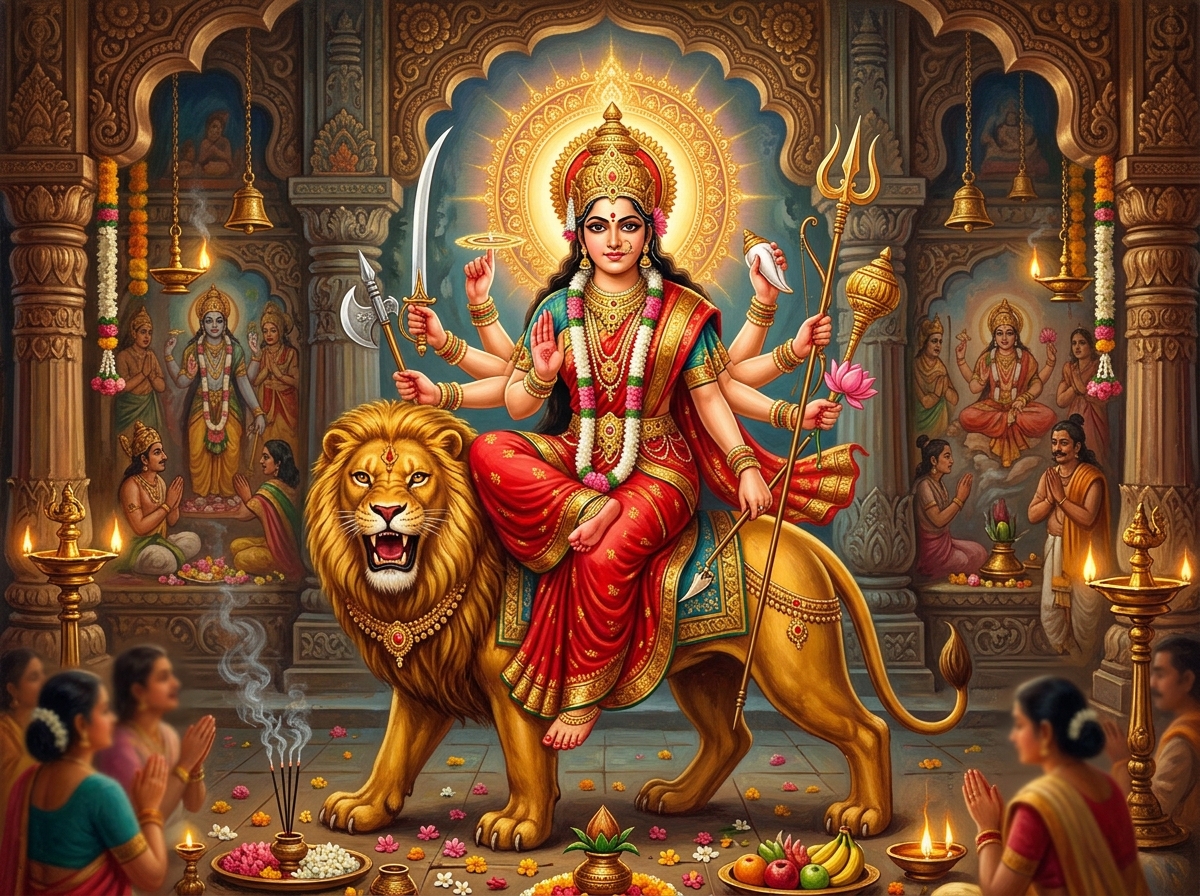
Navratri (Nava = nine, Ratri = nights) is the nine-night festival dedicated to the worship of Goddess Durga in her nine forms (Navadurga). It is observed twice yearly in the Hindu calendar:
- Chaitra Navratri — in spring (March-April), ending on Ram Navami
- Sharad Navratri — in autumn (September-October), the most widely celebrated, ending on Vijayadashami (Dussehra)
Two smaller Navratris also occur in other months but are observed primarily by dedicated Shakta devotees.
The Origin Story
Long ago, the demons Shumbha and Nishumbha conquered the three worlds and drove the gods from heaven. In desperation, all the gods approached the Himalayas and sang praises to Goddess Parvati — the supreme Shakti. From Parvati’s body emerged the radiant Goddess Ambika (Durga), who agreed to fight the demons.
The battle lasted nine days and nights. Each night, a different demon commander — with a different kind of power — attacked the Goddess. Each night, she manifested a different form (rupa) to defeat that specific challenge. On the tenth day (Vijayadashami), she slew Shumbha and Nishumbha themselves, restoring heaven to the gods.
The nine nights of Navratri commemorate this cosmic battle — and the nine forms the Goddess took in those nine nights.
The Nine Goddesses (Navadurga)
Day 1: Shailputri (Daughter of the Mountain)
Meaning: Shaila = mountain; Putri = daughter
The first form represents Goddess Parvati, daughter of the Himalayas. She rides a bull (Nandi) and carries a trident and lotus.
Spiritual significance: The mountain represents the quality of sthirta — stability, groundedness. This form teaches: begin your spiritual journey from a stable foundation.
Color: Grey
Day 2: Brahmacharini (The Austere Seeker)
Meaning: Brahma = the divine; Charini = one who follows
This form represents Parvati’s intense austerities (tapas) to win Lord Shiva as her husband. She walks barefoot, carrying a rosary and a water pot.
Spiritual significance: Discipline and perseverance on the spiritual path. Nothing of value comes without sustained effort.
Color: Orange
Day 3: Chandraghanta (Moon-Bellshaped)
Meaning: Chandra = moon; Ghanta = bell
After her marriage to Shiva, Parvati adorned herself with a crescent moon on her forehead shaped like a bell. She is the warrior form, riding a tiger, ready for battle.
Spiritual significance: The integration of beauty and strength, grace and power. The devotee who has done the inner work now faces the world with courage.
Color: White
Day 4: Kushmanda (Cosmic Egg)
Meaning: Ku = small; Ushma = warmth/energy; Anda = egg
This form created the universe through her divine smile — srishti. She resides in the sun and her body radiates solar energy. She has eight arms.
Spiritual significance: Creative power and the origin of all life. This form connects the devotee to the primordial creative energy.
Color: Red
Day 5: Skandamata (Mother of Skanda)
Meaning: Mother of Lord Skanda (Kartikeya), the commander of the gods
She holds her infant son Skanda in her arms while sitting on a lotus, riding a lion.
Spiritual significance: Unconditional love and nurturing. The divine mother who holds even the greatest warrior as a child in her arms.
Color: Royal Blue
Day 6: Katyayani (Born of Sage Katyayana)
Meaning: Born as the daughter of the sage Katyayana to destroy Mahishasura
She is a fierce warrior form with four arms, riding a lion. She carries a sword and lotus.
Spiritual significance: Righteous anger as a tool of justice. The courage to face what must be confronted and the strength to act for the good.
Color: Yellow
Day 7: Kalaratri (Dark Night of Time)
Meaning: Kala = dark/time; Ratri = night
The most fearsome form — black-skinned, wild hair flowing, riding a donkey. She holds a scimitar, a torch, a noose, and holds the abhaya gesture.
Spiritual significance: The destroyer of all illusions and all darkness. When the Goddess removes the veil of maya, even the most terrible-looking truth is ultimately liberating.
Color: Green
Day 8: Mahagauri (The Supremely White)
Meaning: Maha = great; Gauri = fair/golden/white
After her austerities, Shiva bathed Parvati in the waters of the Ganga, restoring her golden-white complexion. She is serene, pure, peaceful — riding a white bull.
Spiritual significance: Purity achieved through spiritual practice. The devotee who has passed through all the challenges emerges purified and radiant.
Color: Peacock Green
Day 9: Siddhidatri (Bestower of All Powers)
Meaning: Siddhi = divine accomplishment; Datri = giver
The final form who sits on a lotus and bestows all the divine siddhis (powers and accomplishments) upon worthy devotees. She has four arms and is worshipped by all gods.
Spiritual significance: The integration of all powers and wisdom. The culmination of spiritual practice — not power for its own sake, but all powers in service of the divine purpose.
Color: Purple
The Nine Colors of Navratri
| Day | Goddess | Color | Meaning |
|---|---|---|---|
| 1 | Shailputri | Grey | Strength, balance |
| 2 | Brahmacharini | Orange | Creativity, auspiciousness |
| 3 | Chandraghanta | White | Purity, peace |
| 4 | Kushmanda | Red | Love, vigor |
| 5 | Skandamata | Royal Blue | Depth, abundance |
| 6 | Katyayani | Yellow | Happiness, wisdom |
| 7 | Kalaratri | Green | Growth, nature |
| 8 | Mahagauri | Peacock Green | Well-being |
| 9 | Siddhidatri | Purple | Ambition, power |
Navratri Puja Vidhi (Daily Worship)
Morning:
- Wake before sunrise, bathe
- Light ghee lamp and incense
- Invoke the day’s specific goddess form
- Chant her specific mantra 108 times
- Recite Durga Saptashati (or sections thereof)
- Offer appropriate flowers and prasad
Evening:
- Perform aarti
- Read or listen to the Navratri katha
- Sing bhajans to the Goddess
Fasting: Many devotees observe a strict fast during all nine days — eating only fruits, dairy, and water. Others observe partial fasts.
Kanya Puja (Girl Child Worship): On the Ashtami (8th day) or Navami (9th day), young girls below puberty are invited as representations of the Goddess herself — their feet are washed, they are offered a meal of puri, halwa, and chana, and given gifts.
Phala Shruti
Navami pūjan kare jo koī, tāke mānas kī āśā pūrī hoī
Navadurgā kī kṛpā se sakhī, bane vīra, dhanī, sukkhī
“Whoever worships the Goddess on Navami — their heart’s desires are fulfilled. By the grace of the nine Durgas, one becomes courageous, prosperous, and joyful.”
The Devi Mahatmya promises: “Whoever worships the Goddess through these nine nights with sincere devotion shall be freed from all afflictions, all poverty, all disease, and all fear. They shall attain divine grace and ultimately liberation.”