॥ Ram Navami ॥
The Birthday of Lord Rama — Chaitra Shukla Navami
What is Ram Navami?
Ram Navami falls on the ninth day of the bright fortnight (Shukla Paksha) of the month of Chaitra (March-April). It celebrates the birth of Lord Rama — the seventh avatar of Lord Vishnu and one of the most beloved deities in the Hindu tradition.
Ram Navami marks the conclusion of the Chaitra Navratri — the nine-day spring festival dedicated to Goddess Durga — and brings its own spirit of joy and celebration.
The Birth of Lord Rama
The Context
King Dasharatha of Ayodhya was one of the most righteous kings who ever lived — but he was childless despite many years of marriage. Sorrowful, he performed the Putrakameshti Yagna (the fire ritual for obtaining a child) with the help of the great sage Rishyashringa.
At the conclusion of the yagna, a divine being emerged from the fire carrying a golden vessel of sacred kheer (rice pudding). This was the grace of Lord Vishnu himself. Dasharatha distributed the kheer among his three wives — Kaushalya (who received the most), Kaikeyi, and Sumitra.
The Birth
On the ninth day (Navami) of the bright fortnight of Chaitra, at noon — when the sun was at its peak, when the air was fragrant with spring blossoms — Queen Kaushalya gave birth to Lord Rama.
At the moment of his birth, the entire universe rejoiced. The gods showered flowers from the heavens. The rivers ran clear. All creatures experienced a moment of inexplicable joy. Sages declared that this child was no ordinary being — the Lord himself had descended.
The other queens also gave birth:
- Kaikeyi — to Bharata
- Sumitra — to Lakshmana and Shatrughna
The four brothers grew up together in Ayodhya, famous for their love and devotion to each other.
The Spiritual Significance of Noon Birth
Lord Rama was born at noon — Madhyahna — when the sun is at its zenith. This is significant:
- The sun at noon represents the full power of illuminating consciousness
- Noon is the time of Brāhma Muhurta of the day — the most spiritually powerful moment
- The noon sun casts no shadow — symbolizing Rama’s nature as one who is transparent, without hidden aspects, Maryada Purushottam — the exemplar of perfect human conduct
The Name “Rama”
| Derivation | Meaning |
|---|---|
| Ram (root: ram) | To delight, to rest, to shine |
| Rantam | In whom the sages delight through meditation |
| Ra + Ma | Ra from Vishnu’s mantra; Ma from Shiva’s mantra — the complete mantra |
| Rāma | He who gives joy; he who is restful; the luminous one |
The sage Vasishtha gave the name Rama at the time of the baby’s naming ceremony (Namakarana Samskara), declaring: “This child shall be known as Rama — for he will bring delight to the entire world.”
The Fourteen Qualities of Rama
The Valmiki Ramayana lists fourteen exemplary qualities possessed by Rama, mentioned when Narada declares him the ideal man:
- Guna sampanna — possessed of all good qualities
- Veeryavaan — powerful and courageous
- Dharmagya — knower of righteousness
- Kritagya — grateful, never forgets a kindness
- Satyavakya — one whose words are always true
- Dridha-vrata — firm in resolve and commitment
- Charitra-vaan — of excellent conduct
- Sarva-bhuta-hite — devoted to the welfare of all beings
- Vidvaan — deeply learned
- Samarthah — capable in all undertakings
- Priyadarshanah — pleasant to behold
- Atmaavan — self-possessed, not moved by trivial matters
- Jitakrodhah — conqueror of anger
- Diptimaan — radiant, shining with inner light
How to Observe Ram Navami
Fasting
Most devotees observe a fruit and dairy fast from sunrise until the noon puja. Some maintain a complete fast until sunset.
The Noon Puja (Most Auspicious)
At noon — the exact time of Rama’s birth — a special puja is performed:
- Set up an image of baby Rama in a cradle
- Bathe the image with Panchamrit
- Offer yellow flowers — mustard, marigolds
- Sing Ram bhajans and aartis
- Recite Ramcharitmanas or Valmiki Ramayana passages
- Offer kheer and fruits as prasad
- Distribute prasad to all present
Reading the Ramayana
Ram Navami is the traditional beginning of a nine-day Ramayana reading (Ramayan Navah Parayan). Devout families complete the reading of the entire Ramcharitmanas over nine days, culminating on Ram Navami.
Processions
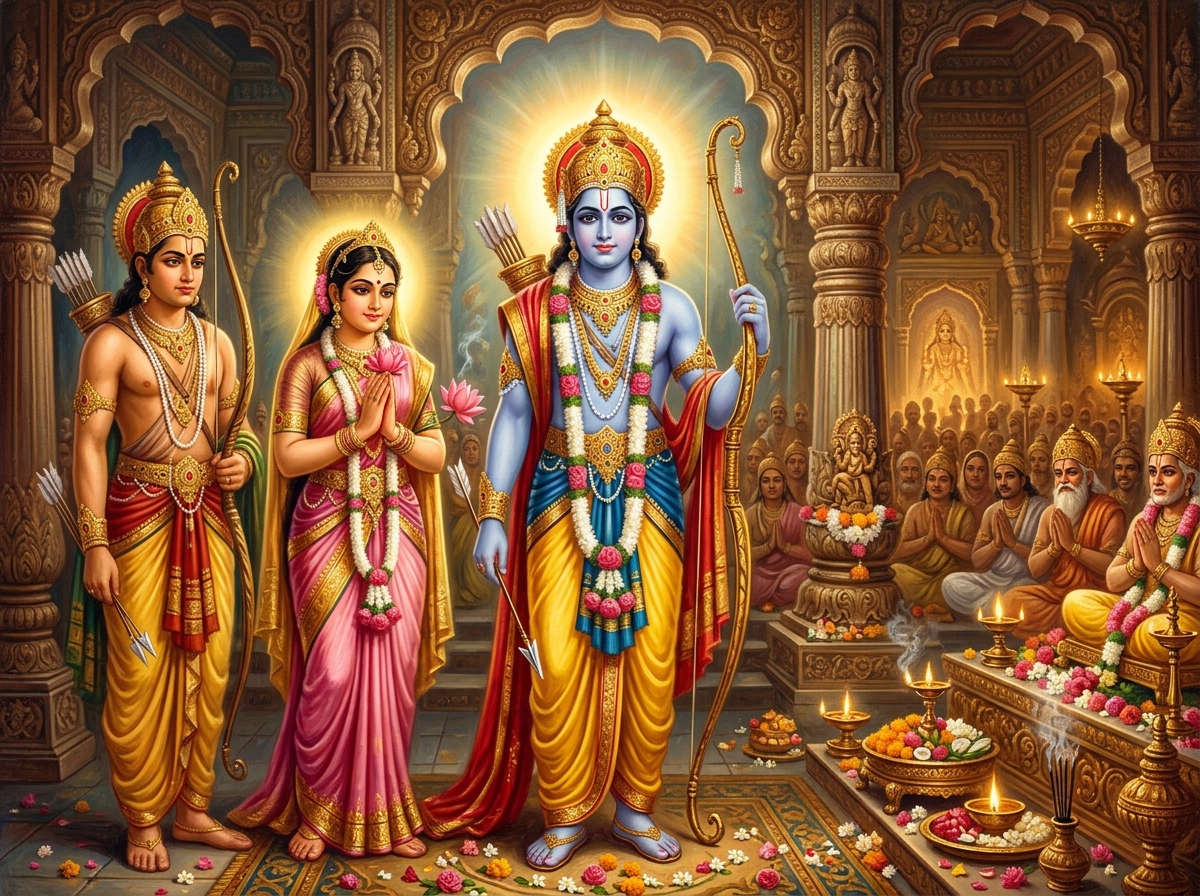
In many towns, especially in northern India and Ayodhya itself, colorful processions (shobha yatra) move through the streets with images of Rama, Sita, Lakshmana, and Hanuman — accompanied by music, bhajans, and showering of flowers.
Ram Navami and Hanuman
Lord Hanuman is inseparable from Ram Navami. The sight of Hanuman’s image is considered most auspicious on this day. Many devotees perform a combined puja — first Hanuman, then Rama — recognizing that Hanuman is the greatest devotee and that approaching Rama through Hanuman’s grace is the most powerful path.
The Hanuman Chalisa is recited on Ram Navami as both a prayer to Hanuman and an indirect prayer to Rama — since Hanuman’s every breath is Rama’s name.
Ayodhya: The Sacred City
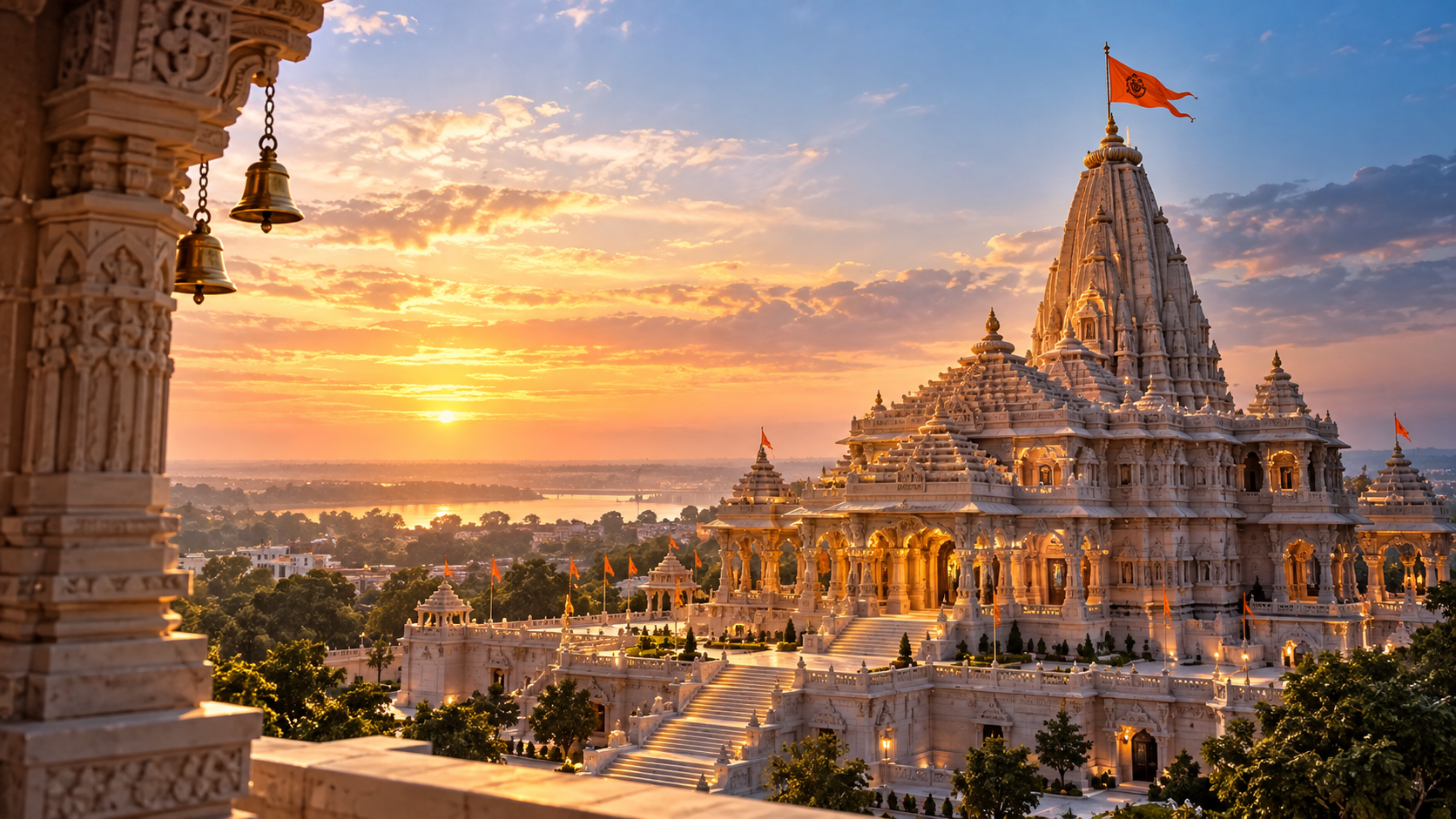
Ayodhya (literally: the city that cannot be conquered) on the banks of the Sarayu river is one of the seven sacred cities (Sapta Puri) of Hindu tradition. On Ram Navami, pilgrims arrive in enormous numbers for a holy bath in the Sarayu and for the elaborate celebrations at the many Rama temples.
The city of Ayodhya is said to be the earthly counterpart of Lord Vishnu’s celestial abode — and visiting it with sincere devotion is considered equivalent to visiting all sacred places simultaneously.
Phala Shruti
Rāma janmotsave bhaktyā, yo pūjayet Rāghavam
Tasya sarva pāpāni naśyaṃti, muktiṃ ca prāpnuyāt
“Whoever worships Lord Raghava (Rama) on his birthday festival with sincere devotion — all their sins are destroyed and they attain liberation.”
The Skanda Purana promises: “Ram Navami is the most auspicious of all ninth-lunar-day celebrations. Whoever bathes, fasts, performs puja, and reads the Ramayana on this day earns merit equivalent to a thousand Ashvamedha yagnas.”
The Living Presence of Rama
The great Tulsidas wrote at the conclusion of the Ramcharitmanas:
Jāke priiya na Rāma Vaidehī
Tijau tāhi koti bairī
“One for whom Rama and Janaki (Sita) are not beloved — abandon such a person, even if they are a crore of your greatest friends.”
Ram Navami is not merely a historical commemoration. It is the annual renewal of our relationship with the ideal of Rama within ourselves — the ideal of truthful speech, righteous action, selfless service, and unconditional love.
Jai Shri Ram.