
॥ Om Namah Shivaya ॥
Transliteration: Om Namaḥ Śivāya
The Five Sacred Syllables (Panchakshara)
The core mantra Na-Ma-Shi-Va-Ya consists of five syllables (pancha akshara), each representing one of the five elements (pancha bhuta) and one of the five acts of Lord Shiva:
| Syllable | Element | Shiva’s Act | Body Region |
|---|---|---|---|
| Na | Earth (Prithvi) | Concealment (Tirodhana) | Feet |
| Ma | Water (Jala) | Grace (Anugraha) | Navel |
| Shi | Fire (Agni) | Destruction (Samhara) | Shoulders |
| Va | Air (Vayu) | Sustenance (Sthiti) | Mouth |
| Ya | Space (Akasha) | Creation (Srishti) | Crown |
Complete Meaning
Om — The primordial cosmic sound, the sacred syllable of the absolute.
Namah — I bow, I surrender, I offer reverence.
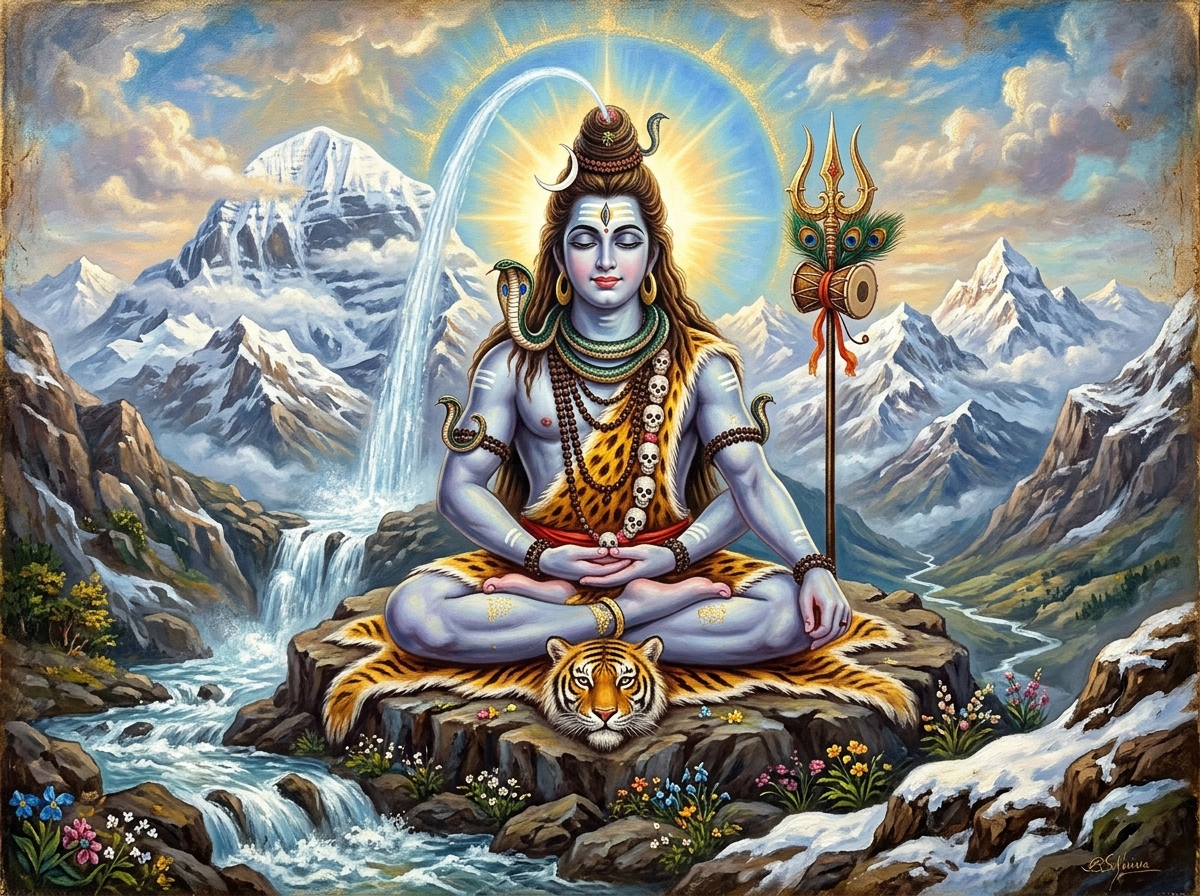
Shivaya — To Shiva — the auspicious one, the supreme consciousness, the destroyer of all that is impure.
“I bow to Lord Shiva — the auspicious one who is the inner Self of all, the supreme consciousness dwelling within every heart, the eternal and unchanging truth.”
Deeper Meaning
The word Shiva literally means that which is auspicious and pure (Shiva = Sha + Ee + Va = eternal happiness). In Shaivite philosophy (Shaiva Siddhanta), Shiva is not merely a deity but the very nature of pure, undivided consciousness that underlies all existence.
When we say Namah Shivaya, we are not merely bowing to an external god. We are recognizing that our own deepest nature is Shiva — pure, unchanging awareness. The chanting dissolves the illusion of separation between the individual self and the universal Self.
Origin
This mantra originates from the Shri Rudram — specifically the Ashtadhyayi section of the Krishna Yajurveda (Taittiriya Samhita 4.5.8). The full Panchakshara with the preceding Om is called the Shadakshara Mantra (six-syllable mantra).
The great sage Parvati is said to have first received this mantra directly from Lord Shiva, who then taught it to Nandi, who passed it through the lineage of Shaiva saints down to humanity.
Benefits of Chanting
- Purification of all five elements — brings the body, mind, and environment into harmony
- Dissolution of ego — breaks down the illusion of a separate, limited self
- Inner peace — silences the restless mind and brings stillness
- Protection from negativity — the mantra is said to form a shield of divine light
- Healing — the five syllables correspond to the five vital energies (prana) and restore their balance
- Moksha (liberation) — the ultimate gift of sustained practice
Method of Chanting
Best time: Early morning, or any time of day — this mantra has no restrictions
Mala: Rudraksha mala (108 beads), moving one bead per repetition
Posture: Seated comfortably, spine straight, eyes gently closed
Pace: Neither too fast nor too slow — let each syllable resonate
Breath: Inhale Om Namah — exhale Shivaya
Short practice for beginners: Chant 108 times after bath, before breakfast. Within 21 days, notice the quality of peace in your day.
Significance in Shaiva Tradition
The great Tamil saint Manikkavachakar wrote: “Namasivaya Valga — may the Panchakshara mantra prosper forever!” The Tirumurai — the sacred Tamil Shaiva scripture — is filled with hymns proclaiming that Namah Shivaya alone is sufficient for liberation.
The Shaiva Siddhanta philosophy teaches that the five letters correspond to:
- Na — the soul (Nara)
- Ma — the bond (Mala)
- Shi — Lord Shiva (Shiva)
- Va — His grace (Arul)
- Ya — the individual self being transformed by grace
Thus the very mantra describes the entire spiritual journey — from bondage to liberation.
Phala Shruti
Namah Shivaya shantaya, sarva papa haraya cha
Mokshadaya prasannaya, namo Rudra Namas te॥
“Salutations to the peaceful Shiva who destroys all sins, who grants liberation, who is ever gracious — salutations, salutations to Rudra!”