
॥ Om Namo Narayanaya ॥
Transliteration: Om Namo Nārāyaṇāya
The Eight Sacred Syllables (Ashtakshara)
This mantra contains eight syllables (Na-Mo-Na-Ra-Ya-Na-Ya with Om), making it the supreme Ashtakshara Mantra of the Vaishnava tradition:
| Syllable | Meaning | Significance |
|---|---|---|
| Om | The absolute Brahman | The sound of the universe |
| Na | Not mine — surrender of ego | Freedom from pride |
| Mo | My salutation | Act of reverence |
| Na | Narayana himself | The Lord |
| Ra | His radiance and grace | Divine light |
| Ya | Who is addressed | The Divine “You” |
| Na | Ever new, ever present | Eternal freshness |
| Ya | To You, for You | Complete offering |
Complete Meaning
Om — The primordial sound of the cosmic absolute.
Namo — I bow, I surrender, I take refuge.
Narayanaya — To Narayana — the supreme Lord who is the inner dweller of all hearts, the eternal support of all creation.
“I offer myself in complete surrender to Lord Narayana — the supreme, all-pervading consciousness who is the ultimate refuge, the innermost Self of all beings, and the eternal ocean of divine bliss.”
Who is Narayana?
Narayana is one of the most profound names of Lord Vishnu, derived from:
- Nara — the waters of cosmic creation, or all souls (jivas)
- Ayana — the dwelling place, the goal, or the abode
Thus Narayana means: He who is the dwelling of all souls; He who resides in all beings; He toward whom all souls move.
In the Narayana Upanishad, it is declared: “Narayana is Brahman (the absolute reality). Narayana is the highest (Paratattva). Narayana is the supreme light. Narayana is the infinite self.”
Origin
This mantra is the central mantra of the Sri Vaishnava tradition. It was given by Lord Vishnu himself to Brahma at the beginning of creation. In the Bhagavata Purana, sages declare this mantra as the very seed of all liberation (taraka mantra).
The great Vaishnava acharya Ramanujacharya made this mantra accessible to all people regardless of caste or status — an act of revolutionary spiritual democratization in medieval India.
Benefits of Chanting
- Surrender of ego — the deepest spiritual benefit; dissolves the illusion of separateness
- Divine protection — Lord Vishnu is the cosmic preserver; his mantra surrounds the devotee with protection
- Inner peace — calms the fluctuating mind and anchors it in the Lord’s presence
- Removal of obstacles — clears the path for spiritual progress
- Liberation — the Ashtakshara is considered a moksha mantra in the Vaishnava tradition
- Grace of Lakshmi — as the mantra of her Lord, Goddess Lakshmi’s blessings naturally follow
Method of Chanting
Best time: At dawn (Brahma Muhurta) or at twilight
Mala: Tulsi mala (most sacred for Vishnu mantras)
Repetitions: 108 times per sitting, or 1008 for special occasions
Direction: Face east or north
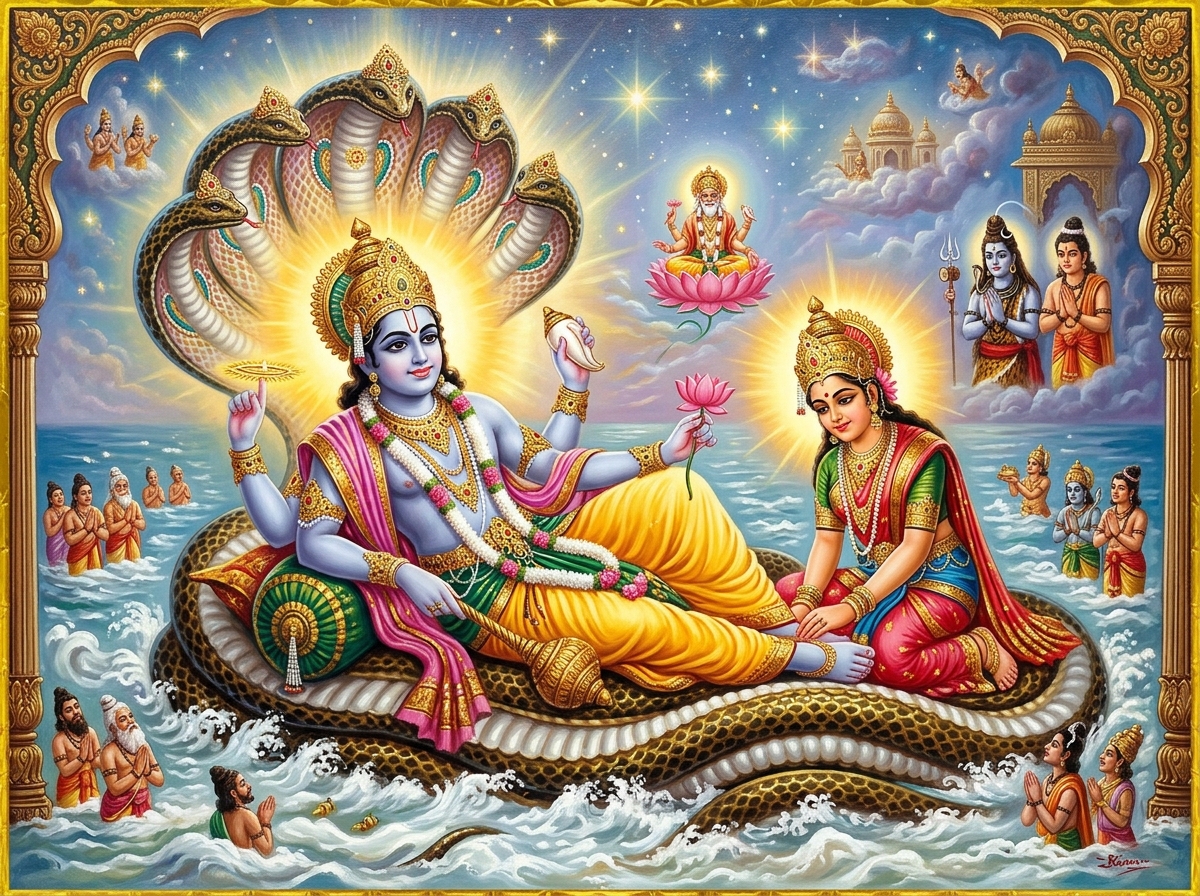
Meditation image: Visualize Lord Vishnu in his four-armed form, blue-skinned, holding conch, discus, mace, and lotus, reclining on Adishesha
Panchamrita Puja (Five-nectar offering):
Before beginning, offer milk, curds, honey, ghee, and sugar to a Vishnu image or Shaligrama stone.
The Tradition of Panchasamskara
In the Sri Vaishnava tradition, the Ashtakshara mantra is formally given during an initiation ceremony called Panchasamskara (five sacred marks). The disciple receives the mantra secretly in the right ear from an authorized teacher (acharya). This initiation transforms the relationship between the soul and the Lord.
The tradition teaches that even a single earnest utterance of Om Namo Narayanaya can release the soul from the chains of repeated birth and death.
Phala Shruti
From the Narayana Upanishad:
Namo Narayanaya — iti mantraraja
Sarva papa vimochana, sarva kama prada
“Om Namo Narayanaya — this king of all mantras removes all sins and fulfills all desires of the devotee who chants it with sincere devotion.”
Connection with Vishnu Sahasranama
The Vishnu Sahasranama teaches that chanting the name Narayana alone is equivalent to chanting all one thousand names. The Mahabharata records Bhishma saying to Yudhishthira on his deathbed: “If a man chants the name Narayana with unwavering devotion, I can declare with certainty that he will cross over all suffering.”