॥ Shri Ram Mantra ॥
The Primary Mantra
Śrī Rāma Jaya Rāma Jaya Jaya Rāma
Meaning: Victory to Lord Rama, glory to Lord Rama — victory, victory to Lord Rama!
The Taraka Mantra (Monosyllabic Seed)
Rāma
The single name Ram is known as the Taraka Mantra — the ferry-mantra that carries the soul across the ocean of worldly existence. In the Yoga Vasishtha, sage Vasishtha tells Rama himself: “Your name, O Lord, contains more power than your very form.”
Rama Nama Taraka Mantra
Om Śrī Rāmāya Namaḥ
Meaning: Om — I bow to the glorious Lord Rama.
The Meaning of “Rama”
The name Rāma is composed of two sacred syllables:
| Syllable | Source | Meaning |
|---|---|---|
| Ra | Drawn from the Narayana Ashtakshara (Om Namo Narayanaya) | The fire syllable; the seed of Vishnu’s mantra |
| Ma | Drawn from the Shiva Panchakshara (Om Namah Shivaya) | The seed of Shiva’s mantra |
Thus the name Rama contains within it the essence of both the supreme Vaishnava and Shaiva mantras — making it a complete mantra in itself, accepted by all traditions.
Ram also means: He who illuminates, He who brings joy, He in whom the yogis delight (from the root ram = to be delighted, to shine).
Origin & Significance
Lord Rama is the seventh avatar of Lord Vishnu, born in Ayodhya to King Dasharatha and Queen Kaushalya. His life and teachings, preserved in Valmiki’s Ramayana and Tulsidas’s Ramcharitmanas, represent the ideal of righteousness (dharma), unconditional love, and selfless service.
The great sage Valmiki himself was transformed from a highway robber by chanting the name Rama. The legend says he was instructed to chant “Mara Mara” (meaning “die” repeatedly) which when chanted continuously became Rama Rama — and this transformed his entire being.
Benefits of Chanting
- Inner strength and courage — Lord Rama embodies fearlessness and righteousness
- Protection in adversity — chanting Jai Shri Ram creates an armour of divine protection
- Family harmony — Rama represents the ideal son, brother, husband, and king
- Victory over obstacles — as Rama overcame all challenges, his name grants perseverance
- Liberation — the Taraka Mantra carries the soul across the ocean of samsara
- Peace of mind — the name Ram is itself a meditation on pure consciousness
Method of Chanting
Best time: At dawn, or whenever the mind feels turbulent
Mala: Tulsi mala (sacred to Lord Vishnu/Rama)
Repetitions: 108 times; or the traditional 10 million repetitions (koti japa) over a lifetime for complete liberation
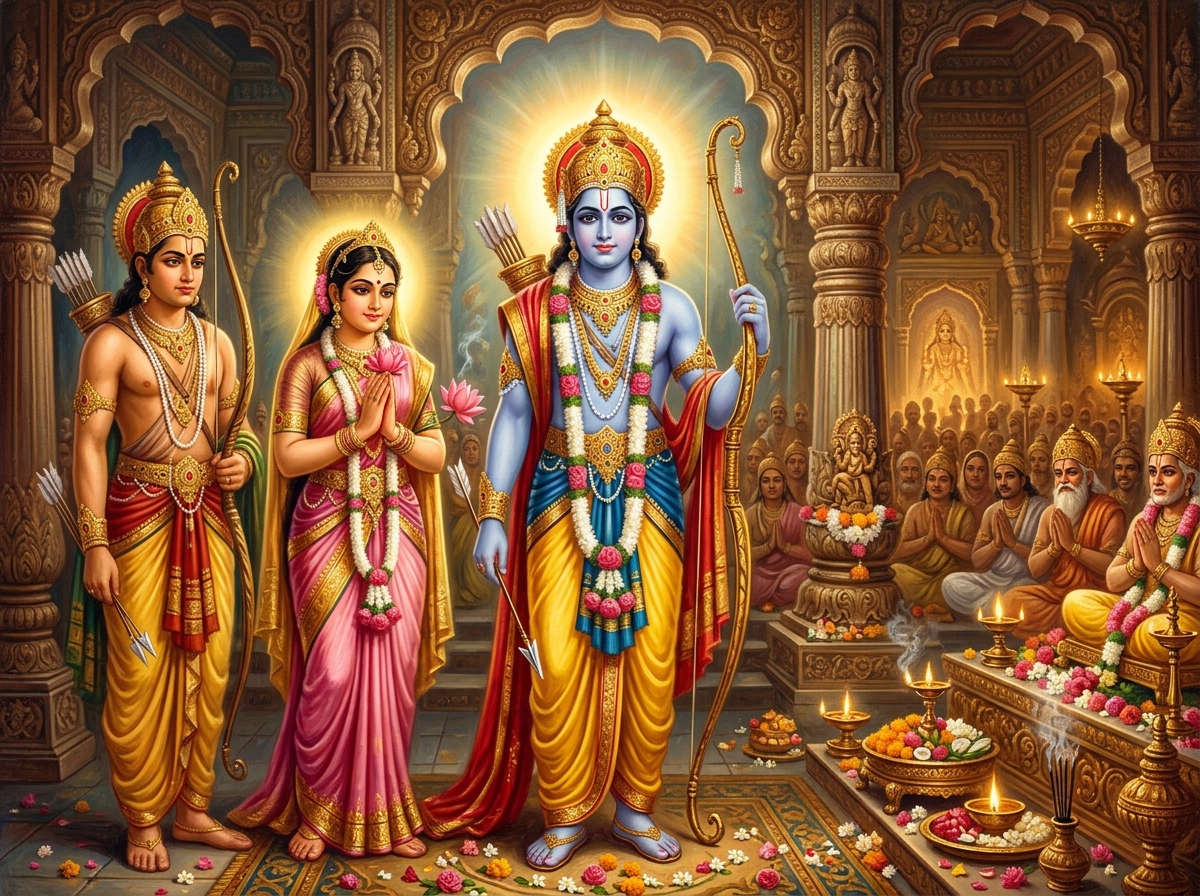
Meditation: Visualize Lord Rama in his blue-skinned form, holding a bow, with Sita on his left and Lakshmana and Hanuman by his side
Simple daily practice:
- Upon waking, before rising, chant Ram Ram 21 times
- Bow mentally to Lord Rama
- Offer the day’s actions to his service
Mahatma Gandhi and Ram Naam
India’s independence movement was deeply connected to the Ram Naam. Mahatma Gandhi made Raghupati Raghava Raja Ram his favorite bhajan and chanted Hey Ram as his last words. He understood Ram not merely as a historical king but as the divine principle of truth, righteousness, and self-sacrifice within every human heart.
Hanuman and Ram Naam
No description of the Ram Mantra is complete without mentioning Lord Hanuman — who is described as the greatest devotee of Lord Rama. The Hanuman Chalisa says: “Ramdoot Atulit Bal Dhama” — Hanuman is the messenger of Ram, his entire being saturated with the Ram Naam. Devotees of Hanuman are thus always devotees of Ram as well.
The 108 Names of Lord Rama (Short Stotra)
Śrī Rāmo Rāmabhadraśca, Rāmacandraśca śāśvataḥ
Rājīvalocan̐śca, Śrīmān rājanīvanalocanaḥ
Lord Rama, the auspicious one, the eternal moon of Rama, lotus-eyed, glorious — these names are the seeds of liberation for those who recite them with love.
Phala Shruti
The sage Agastya declared in the Padma Purana:
Rāma nāma sadā cintan, sarvapāpa pranāśanam
Mokshadaṃ paramānandaṃ, rāmaḥ prītatamā mama
“Constant contemplation of the name Rama destroys all sins, grants supreme bliss, and liberation. Rama is my most beloved.”