
॥ Vishnu Sahasranamam ॥
One Thousand Names of Lord Vishnu — From the Mahabharata
Introduction
The Vishnu Sahasranamam is among the most revered texts in all of Hinduism. It appears in the Anushasana Parva (Book 13) of the Mahabharata, recited by the great warrior-sage Bhishma Pitamah as he lay on his death-bed of arrows after the Kurukshetra war.
When Yudhishthira asked: “O Grandfather, who is the one God? What is the highest duty? By worshipping whom, by chanting whose names, can a person attain liberation?” — Bhishma’s answer was the Vishnu Sahasranamam.
Opening Shloka
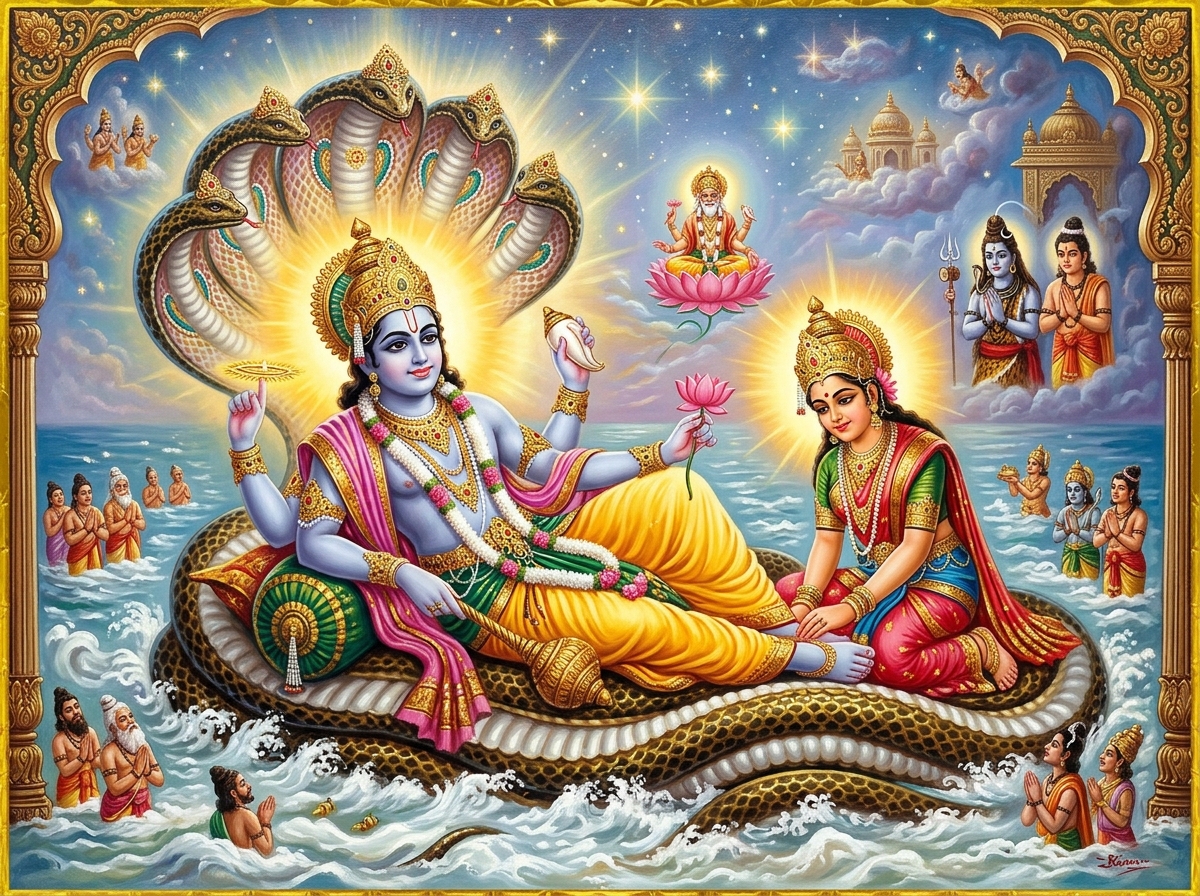
Śuklāmbaradharaṃ viṣṇuṃ śaśivarṇaṃ caturbhujam
Prasannavadanaṃ dhyāyet sarva vighnopaśāntaye
Meaning: We meditate on Lord Vishnu — who wears white garments, who is of the colour of the moon, who has four arms, and whose face is ever cheerful — for the removal of all obstacles.
Dhyanam (Meditation Verse)
Viśuddhajñānadehāya trivedīdivyacakṣuṣe
Śreyaḥprāptinimittāya namaḥ somārddhadhāriṇe
Meaning: To one whose body is pure knowledge, whose vision encompasses all three Vedas, who is the cause of attaining the highest good — salutations to the one who bears the half-moon.
Names 1–100: The First Century
| Names 1–10 | Names 11–20 |
|---|---|
| Visvam — The universe itself | Pootatma — The pure soul |
| Vishnu — The all-pervading | Paramatma — The supreme self |
| Vashatkarah — Called by Vashat | Muktanam paramam gatih — Ultimate goal of the liberated |
| Bhoota-bhavya-bhavatprabhuh — Lord of time | Avyayah — The imperishable |
| Bhootakrit — Creator of beings | Purushah — The cosmic person |
| Bhootabhrit — Sustainer of beings | Sakshi — The eternal witness |
| Bhaavah — Pure being | Kshetrajna — Knower of the field |
| Bhootatma — Inner self of all | Akshara — The indestructible |
| Bhoota-bhavanah — Cause of growth | Yoga — The union itself |
| Pootatma — The holy one | Yogavidham neta — Guide of those who know yoga |
Names 101–200: Key Names with Meaning
| Name | Meaning |
|---|---|
| Ananto | The infinite — without end |
| Huta bhuk | He who accepts all sacrificial offerings |
| Bhavah | He who exists as pure being |
| Ratna garbhah | He whose womb is the earth (jewel-wombed) |
| Dharadhara | He who sustains the earth |
| Deva bhrik | He who sustains the gods |
| Deva namaskrita | Worshipped by the gods |
| Trinetra | Three-eyed one |
| Samara gamana | He who goes to all battles (of righteousness) |
| Havirhari | He who accepts the havis (sacrificial offering) |
| Sarva lakshanah | He who has all auspicious marks |
| Lakshmivaan | He who is adorned with Lakshmi |
| Samitinjaya | Victor in all conflicts |
| Vikshara | He who is beyond the perishable |
| Rohita | The red-complexioned one (solar aspect) |
| Marga | The path itself |
| Hetu | The cause, the reason |
| Damodara | Bound by a rope of love (by his mother Yashoda) |
Names 201–300: The Middle Names
| Name | Meaning |
|---|---|
| Sahah | The patient one, who endures all |
| Mahidharah | The sustainer of the earth |
| Aparajitah | The unconquered, never defeated |
| Sarvadrik | The one who sees all |
| Sarvabhuta namaskritah | Worshipped by all beings |
| Shriman | The one adorned with grace (Shri) |
| Rajadhiraajah | King of all kings |
| Ramah | The one who gives delight |
| Viramah | The ultimate hero |
| Virat omah | He who is the cosmic Virat Om |
| Margah | The eternal path to liberation |
| Neyah | He who leads all beings |
| Nayah | Policy and wisdom personified |
| Anayah | He who requires no guidance (self-sufficient) |
The Six Hundred Names Continue…
(The complete 1000 names are organized in this text as a continuous litany, each name revealing a different facet of the infinite Lord)
Names 301–500 cover Vishnu as the source of all creation, his relationship with Lakshmi, his ten avatars, his cosmic forms, and his role as inner controller.
Names 501–700 describe his qualities of omniscience, omnipotence, omnipresence, and his nature as both the individual self and the universal self.
Names 701–1000 encompass his role as destroyer of evil, liberator of the bound, and ultimate refuge of all creation.
The Uttara Peetika (Concluding Section)
Itīdaṃ kīrtanīyasya keśavasya mahātmanaḥ
Nāmnāṃ sahasraṃ divyānāmaśeṣeṇa prakīrtitam
Meaning: Thus have been proclaimed in full the thousand divine names of the glorious Keshava (Vishnu), the great-souled one, who is worthy of constant praise.
Phala Shruti (Fruit of Recitation)
“These names of the great-souled Vishnu — famous, secondary names sung by the sages — I shall now declare for your welfare.”
The blessings promised:
- Relief from all fear — Vishnu is the cosmic protector
- Healing of disease — the names carry divine healing energy
- Liberation from sin — even the remembrance of Vishnu’s name washes away all accumulated wrong
- Prosperity — Lakshmi, his consort, graces the household of his devotees
- Final liberation — the ultimate fruit: union with Vishnu in Vaikuntha
Method: Recite the complete Sahasranama daily after bathing, facing east. Offer Tulsi leaves. The entire recitation takes approximately 20–30 minutes. Those who cannot recite daily should do so on Ekadashi, full moon days, and Vishnu jayantis.
Bhishma’s Final Promise
As he completed his teaching, Bhishma declared to Yudhishthira:
“These thousand names, O king, are the highest of all prayers. There is nothing more sacred, nothing more purifying. Rama’s name is equal to all one thousand names of Vishnu. Krishna’s name is equal to a thousand repetitions of Rama’s name. Such is the infinite power of divine names.”
With this, the great Bhishma left his body, his eyes fixed on Lord Vishnu — the very fulfillment of his own teaching.