
॥ Vishnu Sahasranamam Stotram ॥
From the Mahabharata, Anushasana Parva — Bhishma’s teaching to Yudhishthira on the battlefield
The Sacred Setting
After the great Kurukshetra War, Bhishma Pitamah lay on his bed of arrows, mortally wounded. This mighty grandfather of the Pandavas — blessed with the boon of choosing his own time of death — waited on the battlefield, using his remaining life to share his wisdom.
When King Yudhishthira asked him: “O Pitamah, who in this world is the one supreme deity? By worshipping whom, by chanting whose name, can a person attain liberation and eternal well-being?” — Bhishma smiled and recited the Vishnu Sahasranamam.
The Opening Verses
Viśvaṃ viṣṇur vaṣaṭkāro bhūtabhavyabhavatprabhuḥ
Bhūtakṛd bhūtabhṛd bhāvo bhūtātmā bhūtabhāvanaḥ
First ten names:
- Vishvam — The universe itself; he who is the entire cosmos
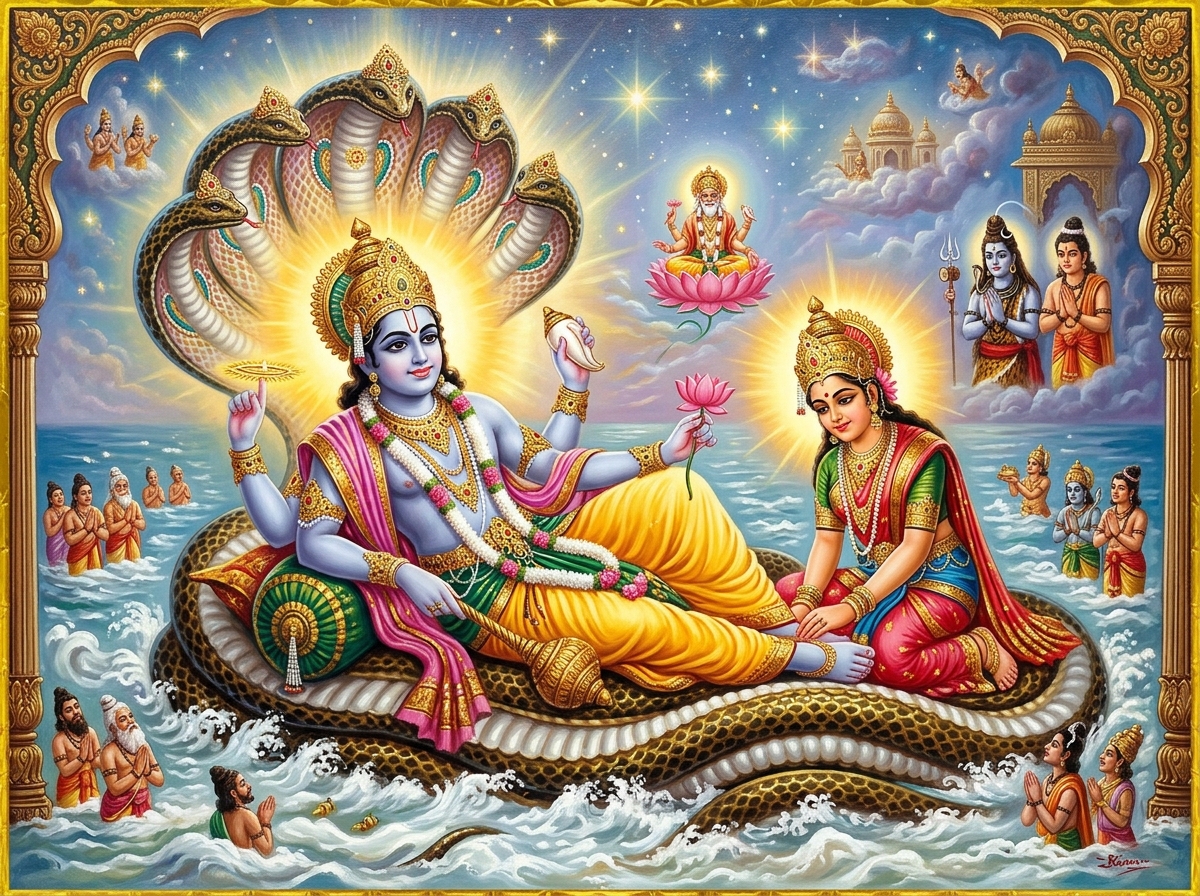
- Vishnu — The all-pervading one; he who fills all space
- Vashatkarah — He in whose name the sacrificial call Vashat is made
- Bhoota-bhavya-bhavatprabhuh — Lord of all that was, is, and will be
- Bhootakrit — The creator of all living beings
- Bhootabhrit — The sustainer who nourishes all living beings
- Bhaavah — The one who exists as pure being
- Bhootatma — The inner Self of all beings
- Bhoota-bhavanah — He who causes beings to flourish and grow
Names 10–50: A Selection
- Pootatma — The pure Self, the holy one
- Paramatma — The supreme Self, the highest consciousness
- Muktanam paramam gatih — The ultimate destination of all liberated souls
- Avyayah — The imperishable, unchanging one
- Purushah — The cosmic Being who dwells in the city of the body
- Sakshi — The eternal witness of all
- Kshetrajna — Knower of the field (the body and all experience)
- Akshara — The imperishable syllable; the indestructible
Names 51–100: A Selection
| Name | Meaning |
|---|---|
| Ananta | The infinite, without end |
| Govinda | Protector of cows and the earth; he who is known through the Vedas |
| Govindam | The chief of the senses |
| Madhava | Husband of Lakshmi (Ma = Lakshmi); lord of spring |
| Narayana | The refuge of all; dwelling in all beings |
| Padmanabha | From whose navel the lotus of creation arises |
| Amritamshudbhava | Born from the nectar-rayed moon |
| Bhanu | The luminous one, like the sun |
| Shashabindu — The moon with the hare symbol | |
| Sureshvara | Lord of the gods |
The Central Philosophical Verse
Yo vedādau svaraḥ prokto vedānte ca pratiṣṭhitaḥ
Tasya prakṛtilīnasya yaḥ paraḥ sa maheśvaraḥ
Meaning: The sound (Om) that is proclaimed at the beginning of the Vedas and is established at the end of the Vedas (Vedanta/Upanishads) — he who is beyond the one who dissolves into nature (Prakriti) — that is the Maheshvara, the supreme Lord.
This profound verse identifies the Supreme Lord Vishnu with the sacred syllable Om and with the highest principle described in the Upanishads (Vedanta).
The Phala Shruti: Fruit of the Thousand Names
Etacchlṛṇoti nityaṃ yaścāpi parikīrtayet
Nāśubhaṃ prāpnuyāt kiñcit so’mutreha ca mānavah
Meaning: Whoever hears this (Sahasranama) daily, or recites it regularly — that person shall encounter no misfortune either in this world or in the next.
What Bhishma Promised
The great teacher Bhishma declared the fruit of reciting the Vishnu Sahasranamam:
- Freedom from all fear — the devotee who recites this is protected by Vishnu on all sides
- Wealth and prosperity — Lakshmi, the consort of Vishnu, blesses the household
- Victory in all endeavours — Vishnu ensures the success of righteous action
- Healing of illness — the divine names carry healing energy
- Long life — one who recites daily shall live a full and blessed life
- Liberation — the ultimate fruit is union with Vishnu in the highest realm
The Supreme Equivalence
Bhishma then made a remarkable statement:
Sahasrasya nāmnāmeva puṇyasya yāvat phalam
Tāvat phalaṃ labhate nara sakṛnmahāprabhum stouvantam
“Whatever merit is obtained by reciting all 1,000 names of Vishnu — that same merit is obtained by reciting the single name ‘Rama’ once.”
And then: “What is obtained by 1,000 repetitions of Vishnu’s name — the same is obtained by once reciting the name ‘Krishna’.”
This is the power of the divine names — not as mere words, but as living presences of the Lord himself.
Method of Recitation
Best time: Morning, after bath and puja
Duration: Full recitation takes approximately 20–30 minutes
Mala: Tulsi mala
Offering: Tulsi leaves placed before Vishnu’s image for each name
Special days: Ekadashi (11th lunar day — Vishnu’s most sacred day)
Short practice: Even reciting the first 10 names daily with full attention brings great benefit.