
॥ Ekadashi Vrat Katha ॥
The Sacred Story of the Eleventh Lunar Day — Lord Vishnu’s Most Beloved Fast
What is Ekadashi?
Ekadashi literally means the eleventh (ekadasha = eleven) — it is the 11th day of both the waxing (Shukla Paksha) and waning (Krishna Paksha) lunar fortnights. There are thus 24 Ekadashis per year (25 in a leap lunar year), each with its own name and specific legend.
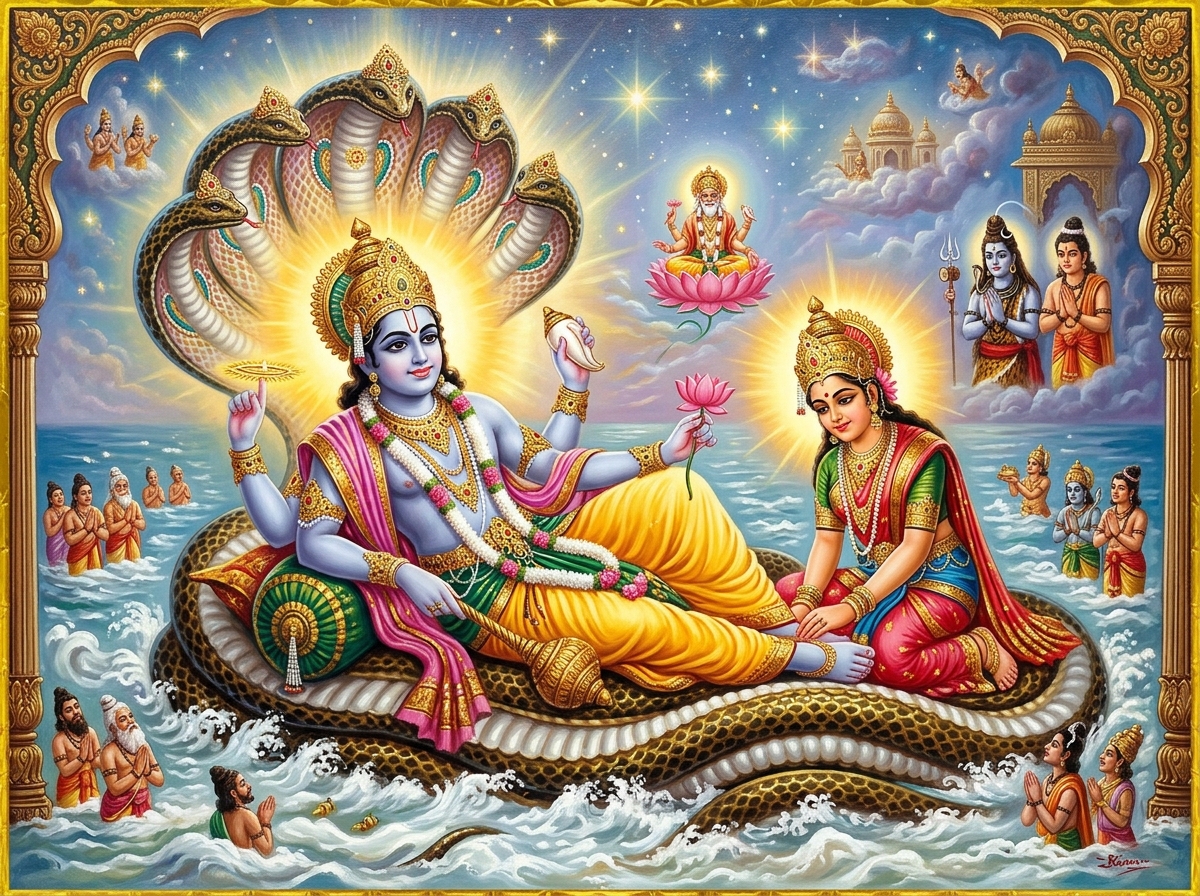
Ekadashi is the most important observance in the Vaishnava tradition — dedicated to Lord Vishnu (in his Narayana aspect). The Padma Purana declares: “All sacred tirthas, all pilgrimages, all penances — their fruit combined equals the fruit of a single Ekadashi fast.”
The Original Story: The Origin of Ekadashi
From the Padma Purana, Uttara Khanda
In the beginning of creation, a demon of immense power was born. This demon was called Murdanav (or Mura) and his sins were so great that they took a specific form — a terrifying being who came to reside inside the stomach of the earth. This demon tormented all the gods and made it impossible for anyone on earth to perform righteous acts.
Lord Vishnu fought with the demon for a tremendous length of time. Finally, exhausted, he entered a cave in the Himalayas called Badarikashrama to rest. The demon followed him, intent on killing him while he slept.
As Vishnu lay sleeping, from his own body emerged a radiant divine maiden — born of his yogic power. This maiden confronted the demon, and after a fierce battle, she slew him.
When Vishnu awoke and saw the dead demon, he was astonished and asked who had fought for him. The maiden introduced herself and Vishnu, delighted, asked her to choose a boon. She said: “O Lord, make this day on which I appeared from you — the 11th day of the lunar fortnight — into a sacred day. May all who fast on this day receive your grace and liberation.”
Lord Vishnu declared: “So be it! This day shall be called Ekadashi, and it shall be the most auspicious of all days. Those who fast on Ekadashi shall be as dear to me as my own devotees. Their sins shall be washed away, and they shall attain liberation.”
The Significance of Ekadashi
Why the 11th day?
The number 11 in Vedic numerology represents the indriyas — the ten sensory and motor organs of the human body, plus the mind. The 11th day fast is thus a day of mastery over the senses — withdrawing the senses from external objects and turning them inward toward the divine.
Physiologically, fasting on Ekadashi (avoiding grains particularly) is also understood in Ayurveda as giving rest to the digestive system, which affects the mind’s clarity and the body’s lightness.
The 24 Ekadashis and Their Names
| Month | Shukla Paksha | Krishna Paksha |
|---|---|---|
| Chaitra | Kamada Ekadashi | Papamochani Ekadashi |
| Vaishakha | Mohini Ekadashi | Varuthini Ekadashi |
| Jyeshtha | Nirjala Ekadashi | Apara Ekadashi |
| Ashadha | Deva Shayani Ekadashi | Yogini Ekadashi |
| Shravana | Putrada Ekadashi | Aja Ekadashi |
| Bhadrapada | Parsva Ekadashi | Indira Ekadashi |
| Ashvin | Papankusha Ekadashi | Rama Ekadashi |
| Kartika | Devotthan Ekadashi | Utpanna Ekadashi |
| Margashirsha | Mokshada Ekadashi | Saphal Ekadashi |
| Pausha | Putrada Ekadashi | Saphala Ekadashi |
| Magha | Jaya Ekadashi | Shat-tila Ekadashi |
| Phalguna | Amalaki Ekadashi | Vijaya Ekadashi |
The most significant are Nirjala Ekadashi (waterless fast — most powerful) and Deva Shayani Ekadashi (the day Lord Vishnu goes to sleep for four months — Chaturmas begins).
The Vrat Vidhi (Fasting Rules)
Dashami (The Day Before):
- Eat a simple, sattvic meal
- Avoid eating after sunset
- Clean the house and prayer area
- Resolve: “Tomorrow I will fast for Lord Vishnu’s pleasure”
Ekadashi (The Fasting Day):
Morning:
- Wake before sunrise
- Bathe and wear clean clothes
- Light a lamp before Lord Vishnu’s image
- Recite Vishnu Sahasranama or Bhagavata
What you can eat:
- Fruits (all types)
- Milk, yogurt, butter
- Nuts and seeds
- Sabudana (tapioca)
- Rock salt
- Sweet potatoes
What you avoid:
- All grains (rice, wheat, barley, lentils)
- Regular salt
- Onion and garlic
- Meat and alcohol
Evening:
- Light a tulsi deepa (lamp near the holy basil plant)
- Read or listen to the Ekadashi Katha
- Sing Vishnu bhajans
Night:
- Stay awake if possible (Jagran — vigil)
- Contemplate Lord Vishnu
- If sleep comes, rest briefly and wake for early morning prayer
Dwadashi (The Breaking Day):
- Break the fast in the early morning (after sunrise but before the Dwadashi time ends)
- Offer food to a Brahmin or donate food to the poor before eating yourself
- Eat a simple, grain-based meal
Phala Shruti
“Ekadashyāṃ tu yo bhakto nārāyaṇam upāsate
Sa yāti paramāṃ śāntiṃ, nāsya punarbhavo bhavet”
“The devotee who worships Lord Narayana on Ekadashi attains supreme peace. For that person, there is no further rebirth.”
The Padma Purana promises: the merit of a single Ekadashi fast equals a thousand Ashvamedha yagnas and a hundred Rajasuyā yagnas. Whoever maintains this vrat faithfully for three consecutive years shall reach Vaikuntha (the eternal abode of Lord Vishnu).