
॥ Satyanarayan Vrat Katha ॥
The Story of Lord Satyanarayan — From the Skanda Purana
Introduction
Satyanarayan Puja is one of the most widely performed pujas in Hindu homes. It is offered:
- When a wish is fulfilled (as an act of gratitude)
- To seek blessings for a new beginning (marriage, new home, new business)
- On auspicious lunar days (Purnima, Ekadashi, Sankranti)
- During festivals
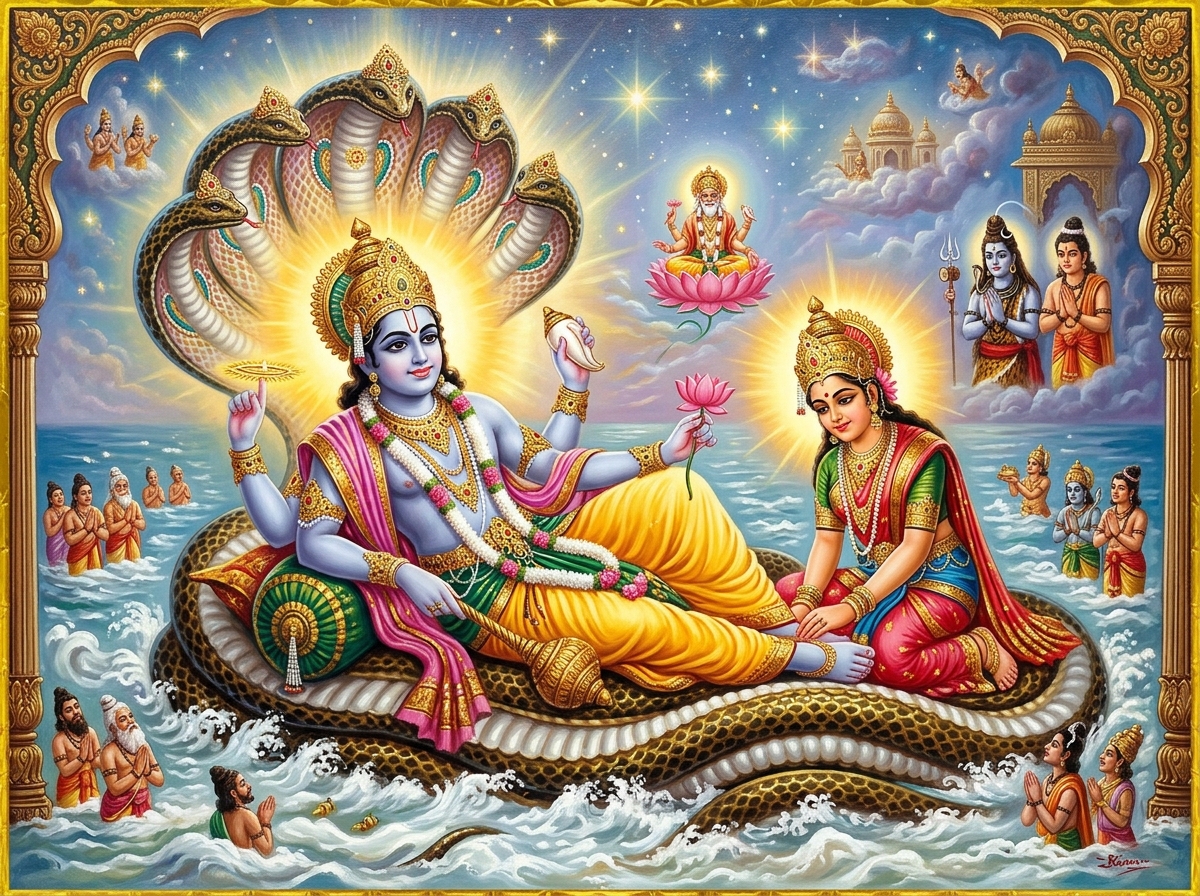
Satyanarayan = Satya (truth) + Narayan (Lord Vishnu, the sustainer). Lord Satyanarayan is Vishnu in his aspect as the Lord of eternal truth — the deity who rewards sincere devotion and punishes pride and dishonesty.
Part 1: How the Vrat Was Revealed
Long ago, the great sage Narada was travelling through the world and was distressed to see the suffering of human beings — poverty, disease, family discord, and grief.
He went to Lord Vishnu’s celestial abode and asked: “O Lord, please tell me — by what means can ordinary human beings be freed from their suffering? Is there a simple practice that everyone can follow?”
Lord Vishnu smiled and said: “O Narada, I am pleased by your compassion. I will reveal to you the Satyanarayan Vrat — the simplest and most powerful of all rituals. Whoever performs this puja with sincere faith receives all their desires and is freed from all difficulties.”
Narada then went to earth and taught this vrat to all beings.
Part 2: The Story of the Woodcutter
In the city of Kashi, there lived a very poor woodcutter. Every day he would walk miles into the forest, cut wood, sell it in the market, and with that small income barely sustain himself and his family.
One day, Lord Vishnu — disguised as an old Brahmin — appeared before the woodcutter and asked: “O friend, why are you so troubled?”
The woodcutter explained his poverty. The Brahmin said: “Perform the Satyanarayan Vrat with sincerity. Offer Panchamrit, prasad made of flour, banana, sugar, and milk. Read the Katha. The Lord will be pleased and your sufferings will end.”
The woodcutter did as instructed. His situation began to improve. He performed the puja regularly, and slowly his business grew, his health returned, and peace came to his home.
The lesson: Even the simplest life, offered in devotion to the Lord of Truth, becomes filled with grace.
Part 3: The Story of the Merchant Sadhu
A wealthy merchant named Sadhu was childless despite many years of marriage. He performed the Satyanarayan Vrat with his wife, praying for a child. A daughter was born — he named her Kalavati.
When Kalavati grew up and was married, her husband — a trader — left for a distant land. Years passed with no news. In her grief, Kalavati’s mother reminded her to continue the Satyanarayan Vrat.
The merchant husband had forgotten his religious duties. While away, he was arrested falsely and imprisoned. In prison, he remembered the Satyanarayan Vrat and prayed with sincere regret. Lord Satyanarayan appeared in a dream and told the king the truth. The merchant was released, and he returned home to find his wife and daughter waiting.
The lesson: Forgetting one’s vow to the Lord — even in the success of worldly achievements — brings difficulty. Remembering the Lord through all circumstances is the path of wisdom.
Part 4: The Story of the Proud King
A king was hunting in the forest and came upon a group of cowherds performing the Satyanarayan Puja. Curious, he sat and observed. The cowherds respectfully offered him prasad.
The king, proud of his royal status, refused the prasad with disdain: “I am the king — I don’t eat prasad from cowherds!”
He returned to his palace to find that his wife was unwell, his treasury was depleted, and disorder had broken out in his kingdom. In distress, his ministers told him: “O King, you refused the prasad of Lord Satyanarayan. The Lord is displeased.”
Humbled, the king returned to the cowherds, apologized, accepted the prasad with both hands, and performed his own Satyanarayan Puja. Peace and prosperity were restored.
The lesson: Pride and disrespect toward the sacred — even in a moment of forgetfulness — diminishes the soul and brings loss. Humility before God is the foundation of all blessing.
Part 5: The Story of the Merchant’s Daughter
Kalavati’s husband had returned safely. They celebrated with a grand Satyanarayan Puja, inviting many guests.
After the puja, Kalavati’s husband went to anchor his boat at the river. He left without taking the prasad. Lord Satyanarayan, displeased at this casual treatment, caused his boat to sink. The merchant dived into the water in despair — and as he submerged, he prayed with all his heart. Lord Satyanarayan appeared underwater and said: “Go back and take your prasad respectfully.”
He returned, took the prasad, the boat rose from the water, and his goods were restored.
The lesson: The prasad of the Lord is not a formality — it is the grace of the Lord himself taking form. Receiving it with casual disregard is a form of disrespect. What we take from the divine, we must receive with full awareness and gratitude.
How to Perform Satyanarayan Puja
Preparation
- Choose a clean space and cover it with a clean cloth
- Place a brass or silver image of Lord Satyanarayan (Vishnu) or a Shaligrama stone
- Gather: panchamrit, tulsi leaves, yellow flowers, coconut, banana, milk, sugar, wheat flour for prasad (Panchamrit prasad or sheera)
Panchamrit Abhishekam
Bathe the image with milk, curd, honey, ghee, and sugar water.
Recite the Katha
Read or hear all five parts of the Katha with family members gathered.
Prepare Panchamrit Prasad (Sheera)
Ingredients: 1 cup wheat flour, ½ cup sugar, ½ cup ghee, 1 cup milk, cardamom, raisins, almonds
Roast flour in ghee until golden. Add milk and sugar. Add cardamom and dry fruits. Cook until thickened. Offer to the Lord and distribute to all present.
Concluding Prayer
“Om Satyanarayanaya namah — katha sampurna. Deva prasanno bhavatam. Sarva karyeshu siddhi rastu.”
Phala Shruti
From the Skanda Purana:
Satyanarayan vrata katha śrutvā, yo bhaktyā śrnoti
Tasya sarva mano-rathāḥ siddhyaṃti, dharmo’rthah kāmo mokṣaḥ ca
“Whoever hears or reads the Satyanarayan Vrat Katha with devotion — all their heart’s desires are fulfilled: righteousness, prosperity, love, and liberation.”