

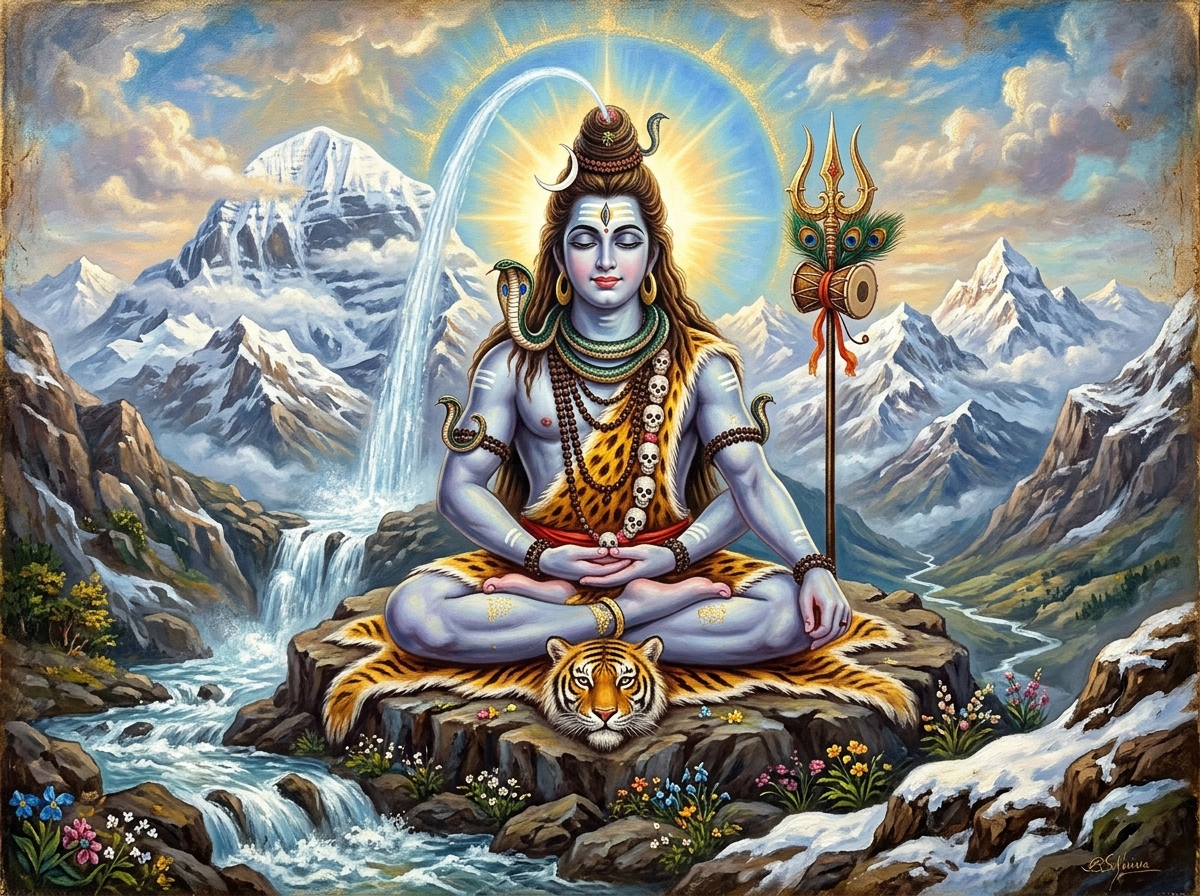
॥ Solah Somvar Vrat Katha ॥
The Story of the Sixteen Monday Fasts for Lord Shiva
Introduction
The Solah Somvar Vrat (Sixteen Monday Fast) is one of the most widely observed fasts in the Shaiva tradition. Observing sixteen consecutive Mondays with devotion to Lord Shiva is believed to fulfill the deepest wishes of the devotee — particularly for marriage, removal of obstacles, and the attainment of Shiva’s grace.
“Somvar” means Monday — named for Soma (the moon), which is closely associated with Shiva. The moon adorns Shiva’s head (Shashishekara — one adorned with the crescent moon). Monday is thus Shiva’s special day.
The Original Story
Long ago, in the divine city of Amravati, Lord Shiva and Goddess Parvati once traveled incognito through a wealthy merchant’s town. In the temple there, they played a game of chess.
Parvati asked: “O Lord, who will win this game?”
The temple caretaker who was present said to Parvati: “My Goddess, Lord Shiva will win.”
Lord Shiva lost the game. Parvati, annoyed that the caretaker had predicted incorrectly, cursed him to become a leper. Years passed.
Some celestial maidens (apsaras) visited the caretaker. Seeing his condition, they told him: “If you observe the sixteen Monday fasts with sincere devotion to Lord Shiva, your condition will be cured.”
The caretaker followed their instruction. After sixteen Mondays, Lord Shiva appeared before him and asked: “What boon do you seek?”
The caretaker said: “O Lord, please free me from this leprosy and restore me to your grace.”
Lord Shiva was pleased. He restored the caretaker’s health and gave him Parvati’s forgiveness as well.
Parvati, witnessing the power of the sixteen Monday fast, asked Shiva: “O Lord, what is this fast that even you were moved by its power?”
Lord Shiva told her: “This is the Solah Somvar Vrat — the most powerful fast for receiving my grace. Whoever observes it with sincere devotion shall have all their wishes fulfilled.”
The Second Part of the Story
Lord Shiva himself then narrated several other tales of the power of this fast:
The Prince Who Lost His Kingdom
A king’s son was banished from his kingdom by his stepmother’s scheming. He wandered for years in poverty. One day he came to a Shiva temple where the priests were teaching the Solah Somvar Vrat.
The prince listened and began observing the fast. After sixteen Mondays, a messenger arrived from his kingdom — his father had died, his stepmother had confessed her crime on her deathbed, and the kingdom was rightfully his.
The teaching: Whatever has been taken from us unjustly — what is rightfully ours — is restored through Shiva’s grace when we approach him in surrender.
The Brahmin’s Daughter
A Brahmin had a beautiful and virtuous daughter, but despite great effort, no suitable marriage could be arranged. The mother heard of the Solah Somvar Vrat and observed it with her daughter. After the sixteenth fast, a young man of excellent character arrived at their door — he became the daughter’s husband.
The teaching: Shiva is called Vivah Poshak — the nourisher of marriage. For those seeking a good partner, the sixteen Monday fast is the traditional recourse.
How to Observe the Vrat
On Somvar (Monday) — The Fasting Day:
Morning:
- Wake early, bathe before sunrise
- Wear clean white or light-colored clothes
- Visit a Shiva temple or worship at home
The Puja:
- Perform Abhishekam with milk, curd, honey, ghee, and gangajal
- Offer bel leaves (21 minimum)
- Offer white flowers and dhatura
- Light a ghee lamp
- Recite Om Namah Shivaya 108 times
- Read the Solah Somvar Vrat Katha (this text)
- Perform aarti
Fasting Rules:
- Eat only once — in the evening, at sunset
- What to eat: fruits, milk, curd, sabudana, rock salt, nuts, sweet potatoes
- What to avoid: grains, regular salt, meat, alcohol, onion, garlic
- If unable to fast strictly: eat a simple vegetarian meal once
Evening:
- Visit the temple again if possible
- Recite Mahamrityunjaya Mantra
The Sixteenth Monday: Udyapan
The sixteenth and final Monday is the Udyapan — the completion ceremony:
- Perform a more elaborate puja with full Panchamrit Abhishekam
- Offer 16 bel leaves, 16 flowers, 16 incense sticks, 16 lamps
- Prepare 16 puris (fried breads) and 16 kheer portions
- Invite 16 Brahmins (or any deserving persons) for a meal
- Offer dakshina (donation) to each
- Read the complete Katha once more
- Express gratitude to Lord Shiva for the sixteen Mondays
The Significance of Sixteen
Sixteen (solah) is significant in Hindu tradition:
- Sixteen kala (arts/phases) of the full moon
- Sixteen kalas of a fully realized being
- Sixteen services (Shodashopachara) in worship
- Sixteen days of Navratri (in its complete extended form)
Completing sixteen represents a full cycle — the moon from dark to full and back. The Solah Somvar Vrat is thus a complete lunar cycle of devotion.
Phala Shruti
The Shiva Purana declares:
Solah Somvara pūjayitvā, Śiva pūjā vidhānatah
Tasya sarva manorathnā, Śambhuḥ pūrayati dhruvam
“One who performs the Shiva puja for sixteen Mondays according to the prescribed method — Lord Shambhu (Shiva) fulfills all their heart’s desires. This is certain.”
Furthermore: “Whoever faithfully observes this vrat — unmarried persons find good partners; those without children are blessed with children; the poor attain prosperity; the sick regain health; and the seeker of liberation receives Shiva’s direct grace.”
Concluding Prayer
At the end of each Monday puja, recite:
“Om Namah Shivaya. This puja is complete. O Lord Shiva, O Mahadeva, please accept this offering made with love and devotion. Grant me your grace. Protect me and my family. O Bholenath — whose heart opens to sincere love — I offer this fast to you. May the power of the Solah Somvar Vrat fulfill my deepest wishes according to your divine will. Om Namah Shivaya.”