

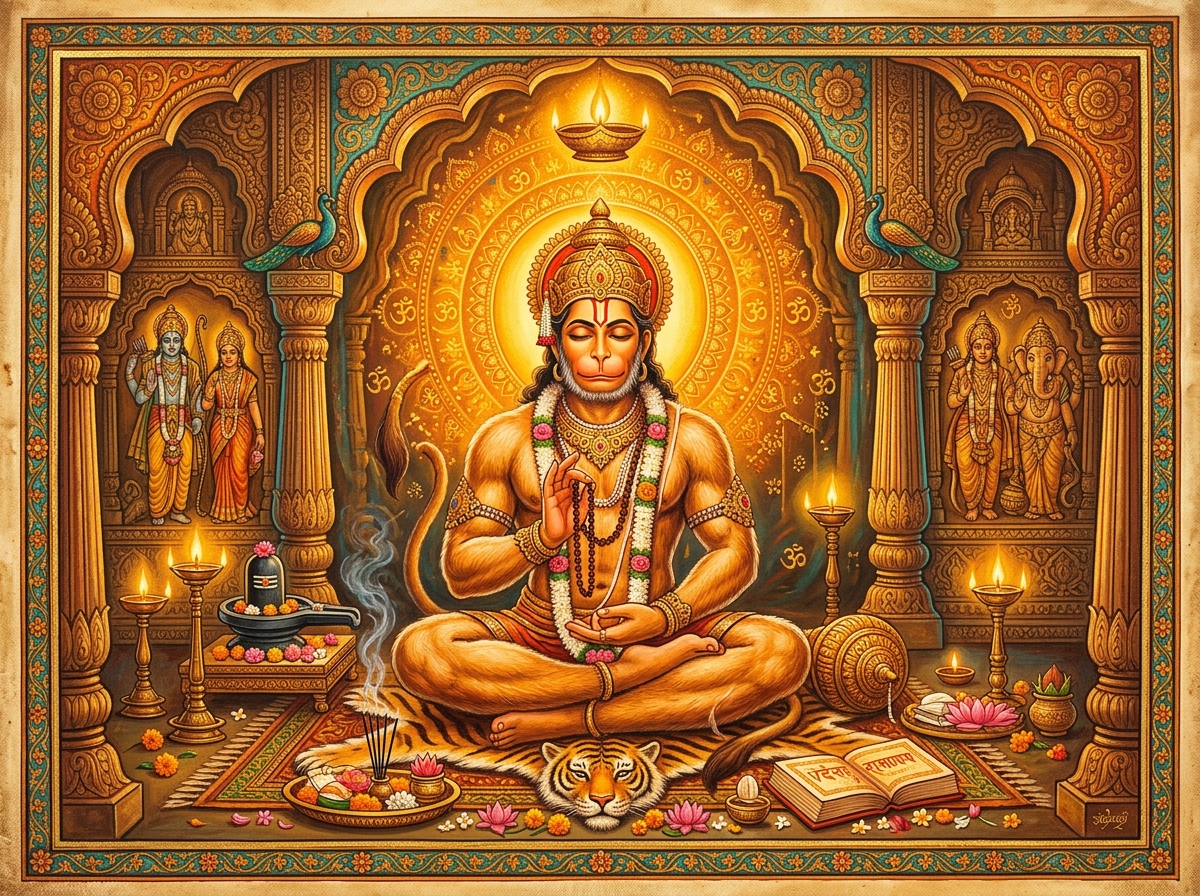
॥ Hanuman Bahuk ॥
Composed by Goswami Tulsidas when he suffered from a painful ailment in his arm — this prayer to Lord Hanuman is one of his most personal and moving compositions
Introduction: The Story of Composition
The great poet-saint Goswami Tulsidas (1497–1623), author of the Ramcharitmanas, once suffered from a severe and debilitating pain in his arm (bahuk = arm). The pain was so intense that he could not write, could not perform puja, and felt cut off from his beloved Lord Rama.
In this state of physical and spiritual anguish, he composed the Hanuman Bahuk — a prayer to Lord Hanuman not merely for healing, but as a profound confession of his own weakness and a desperate petition to the Lord’s grace. The text shows us that even the greatest saints experience suffering and doubt — and that the response to suffering is not stoic endurance but sincere, raw prayer.
Verse 1: Opening Invocation
Śrī guru carana saroja raja, nija manu mukuru sudhāri
Baranaum̐ raghubara bimala jasu, jo dāyaku phala cāri
Meaning: Cleansing the mirror of my mind with the dust of my guru’s lotus feet, I describe the pure and unblemished glory of Lord Rama — which bestows the four fruits of human life.
Verse 2: The Complaint to Hanuman
Bāṃha pīra dhuni bipati hai nātha na dīnī bisāri
Karahu kṛpā Hanumāna raghu-nāyaka ura dhāri
Meaning: O Lord! The pain in my arm is great and my distress is severe — you have not forgotten me in this difficulty. O Hanuman, keeping Lord Rama in your heart, show your grace upon me!
Verse 3: Describing the Suffering
Bāṃha pīra begi harahu Hanumāna balavāna
Jahaṃ jahaṃ nāma raghupati ko tahaṃ tahaṃ rahahu sujāna
Meaning: O mighty Hanuman! Quickly remove this pain in my arm. O wise one, wherever the name of Lord Rama is spoken — there you are always present.
Verse 4: Trust in Hanuman’s Power
Jānatahuṃ asa svāmi soṃ, kāhe na māgasi mora
Kaheu kapīsa kṛpāla, jaga rachibai ko aura
Meaning: Knowing such a compassionate Lord, why do I not ask for his help? The Lord of monkeys — the merciful Hanuman — has been appointed to protect the world. To whom else should I turn?
Verse 5: The Illness Described
Pāṃca pahāṛa pāṃca pāpa, pāṃca bikāra bicāra
Dukhī bibidha bidhi kāya mana, pāya gaye adhikāra
Meaning: Five mountains of pain, five kinds of sin, five mental disturbances — in body and mind I am afflicted in many ways. These afflictions have gained dominion over me.
Verses 6–15: Core Petitions
In the central verses, Tulsidas makes increasingly urgent prayers:
“O Hanuman! You are the destroyer of all suffering. You crossed the ocean in a single leap. You lifted an entire mountain for a single devotee (Lakshmana). Surely this pain in my arm is nothing to you!”
“Just as you brought the Sanjeevani herb that restored Lakshmana’s life — so bring healing to this body of mine, which is the instrument through which I sing the glory of your Lord Rama.”
“I am not asking for wealth or kingdom or fame. I ask only for this: let me be able to hold a pen, and I will spend every breath writing about Lord Rama.”
Verses 16–20: Surrender and Conclusion
Rāmacandra kī sevakī, kari apanī pahacāna
Tāhi duḥkha āpana dekhi, sahi na sakata Hanumāna
Meaning: Recognizing Tulsidas as a servant of Lord Ramachandra, Hanuman cannot bear to see his own servant suffering. The bond of devotion compels the Lord to respond.
The Healing
According to hagiographic accounts, after Tulsidas composed and recited the Hanuman Bahuk with complete devotion, the pain in his arm gradually subsided. The poem stands as a testimony to the power of prayer — not as a magical formula, but as an authentic cry of the heart that reaches the compassionate ear of the Divine.
Spiritual Teaching
The Hanuman Bahuk teaches several profound lessons:
- Illness can be an opportunity for prayer — Tulsidas’s greatest pain produced one of his most moving compositions
- Honesty in prayer is more effective than performance — he did not pretend to be strong; he confessed his weakness
- Hanuman is accessible — unlike remote celestial deities, Hanuman is present wherever his name is spoken
- Devotion to Rama through Hanuman — the path of loving service never abandons the devotee
Benefits of Recitation
- Relief from physical illness — traditionally recited for arm pain, joint pain, and physical suffering
- Mental peace — the honest outpouring of suffering itself brings relief
- Divine protection — Hanuman’s grace descends upon sincere devotees
- Poetic inspiration — the text is itself a masterwork of devotional Hindi poetry
Phala Shruti
Tulasī asa svāmī sevaka yā jaga māhīn
Prabhu dukha bhagatana ko, sahata na kabhuhīn
“Such is the nature of this master and servant relationship in this world: the Lord cannot bear the suffering of his devotees, and will always come to their aid.”